Sunday, October 08, 2006

The New Republic: Denny's Deal is Worse than FoleyGate

Denny Hastert's dodgy real estate deals.
by Norman Ornstein & Scott Lilly

Only at TNR Online
Post date: 10.06.06

Until last week, the broad image of House Speaker Dennis Hastert was of an affable, even grandfatherly figure. But Hastert's response--or lack thereof--to the Mark Foley scandal has suddenly put him in the hot seat, requiring even President Bush to defend him. The Speaker's reputation has taken a serious hit. Still, the image remains of an amiable guy, whose sins are more of sloth than malevolence.

Speaker Hastert, however, is no passive figure. When it comes to running the House, Hastert has, in fact, been an aggressive partisan. Recall, for instance, that he personally fired the chairman and two Republican members from the House Ethics Committee after they had the effrontery to rebuke Tom DeLay for misconduct. And when it comes to real estate, he has been a downright wheeler-dealer. Virtually overnight, the speaker's net worth went from approximately $300,000 to at least $6.2 million--thanks, in no small part, to an earmark he authored.

Hastert's real estate transactions have been reported extensively in the Chicago press and picked apart in a June report issued by the Sunlight Foundation. But they have been largely ignored in the national media. A careful examination of the facts in the case, however, leads to the conclusion that there are compelling reasons beyond the Foley case to call for the speaker's resignation from the post.

Here are the essential facts: In August, 2002, Hastert bought 196 acres of land in rural Kendall County, Illinois for $2,125,000. According to the Chicago Tribune, Hastert bought the plot in two separate transactions. The first deal gave him a house, barn, swimming pool, and 17 acres of land for $1.2 million. In the second deal, he obtained an additional 179 acres on an adjacent property for a little less than $5,200 per acre. The least valuable portions of the second deal were two fields, separated from the rest of the farm by a stream and inaccessible by road.

That was a big deal for a life-long politician and wrestling coach like Hastert, but harmless enough. Eighteen months later, however, Hastert's purchase took a new direction. The speaker entered into a real estate agreement with Dallas Ingemunson, the chair of the Kendall County Republican Party, and a campaign contributor named Tom Klatt. The three men formed a real estate trust and purchased an additional 69 acres of land adjacent to Hastert's two inaccessible fields. The trust paid $1,033,000 for the land, or about $15,000 per acre--more expensive turf than Hastert's plot in part because of its access to a road.

And here's where the deal first begins to acquire a pungent odor: The trust then added Hastert's two fields to the jointly acquired parcel and credited Hastert with 62 percent ownership apparently on the presumption that Hastert's $5,200 land was equal in value to his partners $15,000 land.

These deals coincided with a protracted battle in Congress sparked by the expiration of the 1998 highway bill. Hastert's purchase of his new home and the additional 179 acres of land took place the same month that the House Transportation Committee prepared for its first hearings on a new highway bill--a bill that would be rife with opportunities for members of congress to bring new roads to their districts in the form of earmarks, changes in infrastructure that could have a major effect on real estate values.

A new highway bill, however, didn't neatly wend its way to the president's desk. Members tacked literally thousands and thousands of earmarks to the legislation, wildly inflating its costs and provoking prolonged opposition from the administration. As the President's Fiscal Year 2003 budget warned: "The proliferation of congressional earmarking comes at a cost, in wasted dollars and in unfairness, as when a grant applicant who played by the rules and earned a place at the front of the funding line gets shoved backwards."

There was no better object lesson in the case against earmarks than the Prairie Parkway Corridor, pushed by none other than Denny Hastert. This new highway, designed to connect the counties west of Chicago to the metropolis itself, had neither the support of the public nor the Illinois Department of Transportation. Their objection: Rigid requirements in the highway bill would force the diversion of state funds that might have been used for the widening and improvement of existing roads--an approach, according to opinion polls, favored by a majority of the area's residents--or for more efficient transportation corridors to Chicago. But the Prairie Parkway did offer one important convenience: It was located just over a mile from the property owned by Hastert's trust.

Squabbling over the ballooning cost of the bill might have prevented this highway from ever coming to fruition. But Hastert played an unusually active role in shepherding the legislation, a more aggressive role than he played at any other point in his speakership. His dominance of the process was noted by an Illinois highway official, who remarked, "I think it's truly a recognition of the leadership of Speaker Hastert. Speaker Hastert was able to deliver a bill that made it through Congress that the president could sign, rather than a bill that would make it through Congress that the president would veto." Hastert himself explained at one point in the process that the negotiations had become so intense that he was no longer dealing with White House staff and had begun working directly with the president. When the bill finally passed in the summer of 2005, President Bush also recognized Hastert's efforts by traveling to his district for the bill signing ceremony. Bush also mentioned the Prairie Parkway which he said," is crucial for economic development in Kendall and Kane counties."

It was, we now know, crucial to the speaker's own economic development. In December of 2005, four months after the signing of the new Federal Highway Bill containing the $207 million inserted by Hastert for construction of the nearby Prairie Parkway, the 138 acres held by the trust were sold to a developer as part of planned 1600 home housing development. The trust received $4,989,000 or $36,152 an acre for the parcel of which 62.5 percent or $3,118,000 went to Hastert. Klatt and Ingemunson also did well. Their profit equaled 144 percent of their original investment. Hastert, however, received six times what he had paid for his investment, a profit equal to 500 percent of his original investment.

The Hastert earmark not only provided money for Parkway construction but mandated that the construction take place on the portion of the Parkway nearest his recently purchased property. While the money contained in the highway bill was sufficient to build only about one-third of the entire 36-mile road, the speaker insured that the right third would be selected by also earmarking funds for construction of a interchange in that portion of the proposed thooughfare.

The decision by the developer to build a subdivision in an area proximate to Hastert's farm had financial implications for the speaker that ran well beyond the $2.5 million profit he reaped on the sale. The Tribune has calculated that the remaining 125 acres he still owns is now worth about $4.5 million. Even counting the mortgage on the property, Hastert's net worth, according to the Tribune, appears to be more than $6.2 million. An estimate that Hastert's office does not dispute, probably because it is extremely conservative.

Hastert has responded forcefully to the allegations of venality. "I owned land, and I sold it, like millions of people do every day." The speaker's office has painted a portrait of a guy who just happened to be driving past a house he liked; he bought it and subsequently, in a straightforward transaction, sold some of the land that came with it for a profit.

The speaker hasn't exactly helped his case with his accounts of the transaction. His office has, for instance, described the Prairie Parkway as located over five miles from his property. But U.S. Geological Survey aerial photographs clearly show it to be about four miles closer than that.

We cannot say at this juncture whether the actions taken by the speaker are illegal. We can say that they do not meet the standards we expect--or should expect--from a member of Congress. And they certainly do not meet the standards we expect from the speaker of the House.

Norman Ornstein is a resident scholar at the American Enterprise Institute and co-author of The Broken Branch: How Congress is Failing America and How to Get It Back On Track. Scott Lilly is a senior fellow at the Center for American Progress.

Monday, September 25, 2006

Esquire: 6th District Knife Fight

Esquire, October 2006

A National Knife Fight: Illinois Sixth Congressional District


Click Image to Magnify

Click Image to Magnify

Sunday, September 24, 2006

Roskam: Poured from the old “Leave It to Beaver,” Eddie Haskell mold

Voters will judge these episodes from Roskam’s past


Posted Friday, September 22, 2006

Republican Peter Roskam cuts a smooth figure as he campaigns to succeed retiring Rep. Henry Hyde.

The veteran state lawmaker wants 6th Congressional District voters to send him to Washington, D.C., the planet’s capital of wheeling and dealing. Given that, there are a couple of wheeler-dealer episodes from Roskam’s past they might want to consider.

Not surprisingly, both cases involve Wauconda’s Al Salvi — Roskam’s longtime law partner, conservative confidant, and, like Roskam, a politician who sometimes comes across as poured from the old “Leave It to Beaver,” Eddie Haskell mold.

The first example involves the Sir Thomas More Justice League. Sounds like an organization of Catholic superheroes. But the justice league was a campaign fund-raising scheme devised by Salvi and Roskam in the mid-’90s to capitalize on their planned votes against limits on pain-and-suffering damages in civil lawsuits.

As their thinking went, state House members who dared vote against the measure would be cut off from typical GOP fund-raising sources. So the duo hit up fellow trial lawyers for campaign cash, telling them they wouldn’t vote for tort reform.

Problem was, they included in their sales pitch three other Republican House members, including Rep. Rosemary Mulligan of Des Plaines. And in Mulligan’s case, the duo did so after she told them no and blasted the fund-raising plan as “unethical.” To some, promising to vote a certain way while simultaneously soliciting campaign checks looked an awful lot like selling your vote.

In the end, Roskam bit the bullet and voted for tort reform while Salvi voted present. As a result, they had to refund some of the $70,000 that rolled in.

The other Roskam wheeler-dealer example comes courtesy of Salvi’s failed 1998 bid for secretary of state.

Roskam asked the Illinois comptroller’s office for a list of the names and addresses of more than 3,600 secretary of state employees. “I just wanted to look at the list to find out about the nature of the office,” Roskam claimed to the Chicago Tribune in 1998.

But Roskam also admitted he gave the list to the Salvi campaign, of which he was chairman. Team Salvi used the list to send numbered $50 campaign fund-raising tickets to secretary of state employees. The numbering made it easy for Salvi to track which employees ponied up and which employees didn’t. One ethics watchdog at the time blasted the move as “classic Illinois political prostitution with a twist.”

The twist being that Salvi wasn’t even the boss yet but, using the list Roskam gave him, was asking the workers for money.

As you might recall, then-Secretary of State George Ryan’s top aides also hit up their workers for campaign fund-raising tickets. Many of that crew, including Ryan himself, have been to jail, are currently in jail or are headed to jail after New Year’s Day.

I wanted to ask Roskam if he now regrets either political move, but he didn’t call me back. A campaign operative said “there was nothing worthy of an official inquiry or investigation eight years ago.”

It’ll be up to voters to decide what they think of that answer. Roskam’s opponent, Democrat Tammy Duckworth, has been raising the ethics issue, trying to tie him to scandal-plagued former House Majority Leader Tom DeLay of Texas.

One gets the sense those charges haven’t really stuck — I imagine not too many people in the 6th District know who DeLay is — but these Illinois-based examples could become a different story. After all, probably close to 100 percent of voters in the district are aware of the wheeler-dealer techniques Ryan employed.

While it’s a stretch to link Roskam to Ryan outright — they weren’t politically close — being viewed as a politician prone to wheeling and dealing probably isn’t a positive in this fall’s electoral climate.

http://www.dailyherald.com/search/searchstory.asp?id=230423

Sunday, September 03, 2006

Frank Rich: Rumsfeld's Dance With the NAZIS

September 3, 2006
Op-Ed Columnist
Donald Rumsfeld’s Dance With the Nazis
By FRANK RICH

PRESIDENT BUSH came to Washington vowing to be a uniter, not a divider. Well, you win some and you lose some. But there is one member of his administration who has not broken that promise: Donald Rumsfeld. With indefatigable brio, he has long since united Democrats, Republicans, generals and civilians alike in calling for his scalp.

Last week the man who gave us “stuff happens” and “you go to war with the Army you have” outdid himself. In an instantly infamous address to the American Legion, he likened critics of the Iraq debacle to those who “ridiculed or ignored” the rise of the Nazis in the 1930’s and tried to appease Hitler. Such Americans, he said, suffer from a “moral or intellectual confusion” and fail to recognize the “new type of fascism” represented by terrorists. Presumably he was not only describing the usual array of “Defeatocrats” but also the first President Bush, who had already been implicitly tarred as an appeaser by Tony Snow last month for failing to knock out Saddam in 1991.

What made Mr. Rumsfeld’s speech noteworthy wasn’t its toxic effort to impugn the patriotism of administration critics by conflating dissent on Iraq with cut-and-run surrender and incipient treason. That’s old news. No, what made Mr. Rumsfeld’s performance special was the preview it offered of the ambitious propaganda campaign planned between now and Election Day. An on-the-ropes White House plans to stop at nothing when rewriting its record of defeat (not to be confused with defeatism) in a war that has now lasted longer than America’s fight against the actual Nazis in World War II.

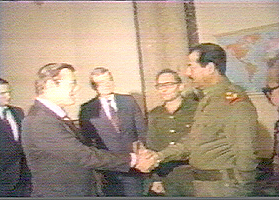
Here’s how brazen Mr. Rumsfeld was when he invoked Hitler’s appeasers to score his cheap points: Since Hitler was photographed warmly shaking Neville Chamberlain’s hand at Munich in 1938, the only image that comes close to matching it in epochal obsequiousness is the December 1983 photograph of Mr. Rumsfeld himself in Baghdad, warmly shaking the hand of Saddam Hussein in full fascist regalia. Is the defense secretary so self-deluded that he thought no one would remember a picture so easily Googled on the Web? Or worse, is he just too shameless to care?

Mr. Rumsfeld didn’t go to Baghdad in 1983 to tour the museum. Then a private citizen, he had been dispatched as an emissary by the Reagan administration, which sought to align itself with Iraq in the Iran-Iraq war. Saddam was already a notorious thug. Well before Mr. Rumsfeld’s trip, Amnesty International had reported the dictator’s use of torture — “beating, burning, sexual abuse and the infliction of electric shocks” — on hundreds of political prisoners. Dozens more had been summarily executed or had “disappeared.” American intelligence agencies knew that Saddam had used chemical weapons to gas both Iraqi Kurds and Iranians.

According to declassified State Department memos detailing Mr. Rumsfeld’s Baghdad meetings, the American visitor never raised the subject of these crimes with his host. (Mr. Rumsfeld has since claimed otherwise, but that is not supported by the documents, which can be viewed online at George Washington University’s National Security Archive.) Within a year of his visit, the American mission was accomplished: Iraq and the United States resumed diplomatic relations for the first time since Iraq had severed them in 1967 in protest of American backing of Israel in the Six-Day War.

In his speech last week, Mr. Rumsfeld paraphrased Winston Churchill: Appeasing tyrants is “a bit like feeding a crocodile, hoping it would eat you last.” He can quote Churchill all he wants, but if he wants to self-righteously use that argument to smear others, the record shows that Mr. Rumsfeld cozied up to the crocodile of Baghdad as smarmily as anyone. To borrow the defense secretary’s own formulation, he suffers from moral confusion about Saddam.

Mr. Rumsfeld also suffers from intellectual confusion about terrorism. He might not have appeased Al Qaeda but he certainly enabled it. Like Chamberlain, he didn’t recognize the severity of the looming threat until it was too late. Had he done so, maybe his boss would not have blown off intelligence about imminent Qaeda attacks while on siesta in Crawford.

For further proof, read the address Mr. Rumsfeld gave to Pentagon workers on Sept. 10, 2001 — a policy manifesto he regarded as sufficiently important, James Bamford reminds us in his book “A Pretext to War,” that it was disseminated to the press. “The topic today is an adversary that poses a threat, a serious threat, to the security of the United States of America” is how the defense secretary began. He then went on to explain that this adversary “crushes new ideas” with “brutal consistency” and “disrupts the defense of the United States.” It is a foe “more subtle and implacable” than the former Soviet Union, he continued, stronger and larger and “closer to home” than “the last decrepit dictators of the world.”

And who might this ominous enemy be? Of that, Mr. Rumsfeld was as certain as he would later be about troop strength in Iraq: “the Pentagon bureaucracy.” In love with the sound of his own voice, he blathered on for almost 4,000 words while Mohamed Atta and the 18 other hijackers fanned out to American airports.

Three months later, Mr. Rumsfeld would still be asleep at the switch, as his war command refused to heed the urgent request by American officers on the ground for the additional troops needed to capture Osama bin Laden when he was cornered in Tora Bora. What would follow in Iraq was also more Chamberlain than Churchill. By failing to secure and rebuild the country after the invasion, he created a terrorist haven where none had been before.

That last story is seeping out in ever more incriminating detail, thanks to well-sourced chronicles like “Fiasco,” “Cobra II” and “Blood Money,” T. Christian Miller’s new account of the billions of dollars squandered and stolen in Iraq reconstruction. Still, Americans have notoriously short memories. The White House hopes that by Election Day it can induce amnesia about its failures in the Middle East as deftly as Mr. Rumsfeld (with an assist from John Mark Karr) helped upstage first-anniversary remembrances of Katrina.

One obstacle is that White House allies, not just Democrats, are sounding the alarm about Iraq. In recent weeks, prominent conservatives, some still war supporters and some not, have steadily broached the dread word Vietnam: Chuck Hagel, William F. Buckley Jr. and the columnists Rich Lowry and Max Boot. A George Will column critical of the war so rattled the White House that it had a flunky release a public 2,400-word response notable for its incoherence.

If even some conservatives are making accurate analogies between Vietnam and Iraq, one way for the administration to drown them out is to step up false historical analogies of its own, like Mr. Rumsfeld’s. In the past the administration has been big on comparisons between Iraq and the American Revolution — the defense secretary once likened “the snows of Valley Forge” to “the sandstorms of central Iraq” — but lately the White House vogue has been for “Islamo-fascism,” which it sees as another rhetorical means to retrofit Iraq to the more salable template of World War II.

“Islamo-fascism” certainly sounds more impressive than such tired buzzwords as “Plan for Victory” or “Stay the Course.” And it serves as a handy substitute for “As the Iraqis stand up, we’ll stand down.” That slogan had to be retired abruptly last month after The New York Times reported that violence in Baghdad has statistically increased rather than decreased as American troops handed over responsibilities to Iraqis. Yet the term “Islamo-fascists,” like the bygone “evildoers,” is less telling as a description of the enemy than as a window into the administration’s continued confusion about exactly who the enemy is. As the writer Katha Pollitt asks in The Nation, “Who are the ‘Islamo-fascists’ in Saudi Arabia — the current regime or its religious-fanatical opponents?”

Next up is the parade of presidential speeches culminating in what The Washington Post describes as “a whirlwind tour of the Sept. 11 attack sites”: All Fascism All the Time. In his opening salvo, delivered on Thursday to the same American Legion convention that cheered Mr. Rumsfeld, Mr. Bush worked in the Nazis and Communists and compared battles in Iraq to Omaha Beach and Guadalcanal. He once more interchanged the terrorists who struck the World Trade Center with car bombers in Baghdad, calling them all part of the same epic “ideological struggle of the 21st century.” One more drop in the polls, and he may yet rebrand this mess War of the Worlds.

“Iraq is not overwhelmed by foreign terrorists,” said the congressman John Murtha in succinct rebuttal to the president’s speech. “It is overwhelmed by Iraqis fighting Iraqis.” And with Americans caught in the middle. If we owe anything to those who died on 9/11, it is that we not forget how the administration diverted our blood and treasure from the battle against bin Laden and other stateless Islamic terrorists, fascist or whatever, to this quagmire in a country that did not attack us on 9/11. The number of American dead in Iraq — now more than 2,600 — is inexorably approaching the death toll of that Tuesday morning five years ago.

Copyright 2006 The New York Times Company
http://select.nytimes.com/2006/09/03/opinion/03rich.html?n=Top%2fOpinion%2fEditorials%20and%20Op%2dEd%2fOp%2dEd%2fColumnists%2fFrank%20Rich

Thursday, August 31, 2006

SunTimes: Immigrants flock to the suburbs

Immigrants flock to the suburbs

August 30, 2006

BY SCOTT FORNEK Political Reporter

The melting pot is bubbling over in the suburbs of Chicago.

The number of foreign-born U.S. citizens jumped by nearly 38 percent in the suburbs over the last five years -- leaping almost 50 percent in DuPage County alone and doubling in Will and Grundy counties, according to an analysis of Census information by a pro-immigrant group.

Calling it "a fundamental sea change of where immigrant citizens are living," the Illinois Coalition for Immigrant and Refugee Rights argues the changes have far-reaching political ramifica- tions.

"We're riding the crest of a tsunami," said Joshua Hoyt, executive director of the group and author of the report.

"Immigrants in Illinois are achieving the American dream of learning English, becoming American citizens and settling in the suburbs with their children.

"Immigrants are the new swing voters, the new soccer moms and NASCAR dads."

The coalition plans to formally release a report on the trend today. It's based on an analysis of the U.S. Census Bureau's latest estimates of population changes since 2000.

More becoming citizens

The group found that between 2000 and 2005, the state's total immigrant population -- including both undocumented residents and naturalized citizens -- rose by 177,000, an influx larger than the population of Aurora, the state's second largest city.

And while Chicago is often heralded as a city of immigrants, its total foreign-born population actually dipped 5 percent in the last five years, the first such drop during the wave of immigration that began in 1965.

Most important politically is the rise in the number of immigrants who have become U.S. citizens, making them eligible to vote. In the last five years the number of naturalized citizens in Illinois rose 23.1 percent, to 736,161.

But the real growth has been in the suburbs.

While Chicago only experienced a 4 percent increase in naturalized citizens of voting age during the period, the suburbs saw a boom of 37.5 percent.

The 48.2 percent rise in DuPage County means that 14.4 percent of its voting age population are naturalized citizens. In Will and Grundy counties, the number of adult naturalized citizens doubled, making them 6.3 percent of the total voting age population.

Which party will they help?

The report does not break down the immigrants by country of origin but notes that more than 100 nations are represented, with Mexico, Poland and India the top three.

"The political significance of this is that suburban communities that were traditionally Republican strongholds are now competitive for Democrats," Hoyt said.

Some studies have shown that Latinos and Asian Americans are more likely to vote Democratic, but Hoyt argues the diverse backgrounds of the immigrants make them fertile political ground for either party.

"The immigrant voters are a real swing constituency," Hoyt said. "They are attracted to the racial big tent of the Democratic Party and its stand on economic issues, but they are also attracted to the social conservatism and the entrepreneurialism that they identify with the Republican Party.

"But the most important thing is when they feel under attack, they will vote against the party they feel is attacking them."

That's a dig at Republicans, who have made curtailing illegal immigration a hot political issue. The coalition is one of the groups that helped organize the pro-immigration marches in Chicago this year.

'Faces that look like me'

As part of its efforts to mobilize the new citizens and realize the "today we march, tomorrow we vote" slogan, the coalition has 18 young people working to register immigrants to vote in suburban areas. Hoyt said they have registered 7,000 since mid-July.

Melissa Garcia, 21, a Harper College student, estimates that 75 percent of the roughly 400 people she has signed up in DuPage County have been immigrants, primarily from Mexico, Central America, South America or Asian countries.

But she said she saw the changes long before this.

The daughter of Mexican immigrants, she grew up in Hanover Park in one of the only households in the area that "was anything other than Anglo."

"Now, my neighbors are Hispanic," she said. "Tons of people are moving in the whole area itself. The percent of immigrants is just rising. I can just see it by looking down my street and seeing more faces that look like me."

'They're all welcome'

Illinois Republican Chairman Andy McKenna Jr. said he is not worried that the changing demographics will hurt the GOP, noting that Bush won 45 percent of the Hispanic vote nationwide.

"I think families of every ethnic makeup in suburban communities care about schools, about jobs and pocketbook issues," McKenna said. "And we have a good story to tell on all of those."

Kane County Clerk Jack Cunningham said Hispanics will continue to gain political power as their numbers grow, as the Irish did before them.

But Cunningham, also a Republican, said it will take a few elections to figure out which party fares better.

"They're all welcome and [I] hope they make the right choice when they vote."

sfornek@suntimes.com

http://www.suntimes.com/cgi-bin/print.cgi?getReferrer=http://www.suntimes.com/output/news/cst-nws-meltpot30.html

Thursday, August 24, 2006

"Pork Barrel" Peter Focuses on Tax Cuts

Roskam focuses on tax cuts

BY PAT CORCORAN | STAFF WRITER
pcorcoran@pioneerlocal.com

GOP congressional candidate and state Sen. Peter Roskam wants to steer the election dialogue toward a conservative stand-by -- cutting taxes.

During an Aug. 2 campaign stop at the Bensenville offices of Central States Trucking, Roskam said that the starkest contrast between himself and Democratic nominee Tammy Duckworth is his pro-growth approach to tax policy.

The state lawmaker has pledged to eliminate the inheritance tax, also known as the "death tax," and said Duckworth needs to clarify to voters her position on taxes.

"I have a record now of almost 13 years in the General Assembly as a tax fighter and I have said unambiguously that I am in favor of making the tax cuts permanent," he said. "My opponent has been very ambiguous on that issue."

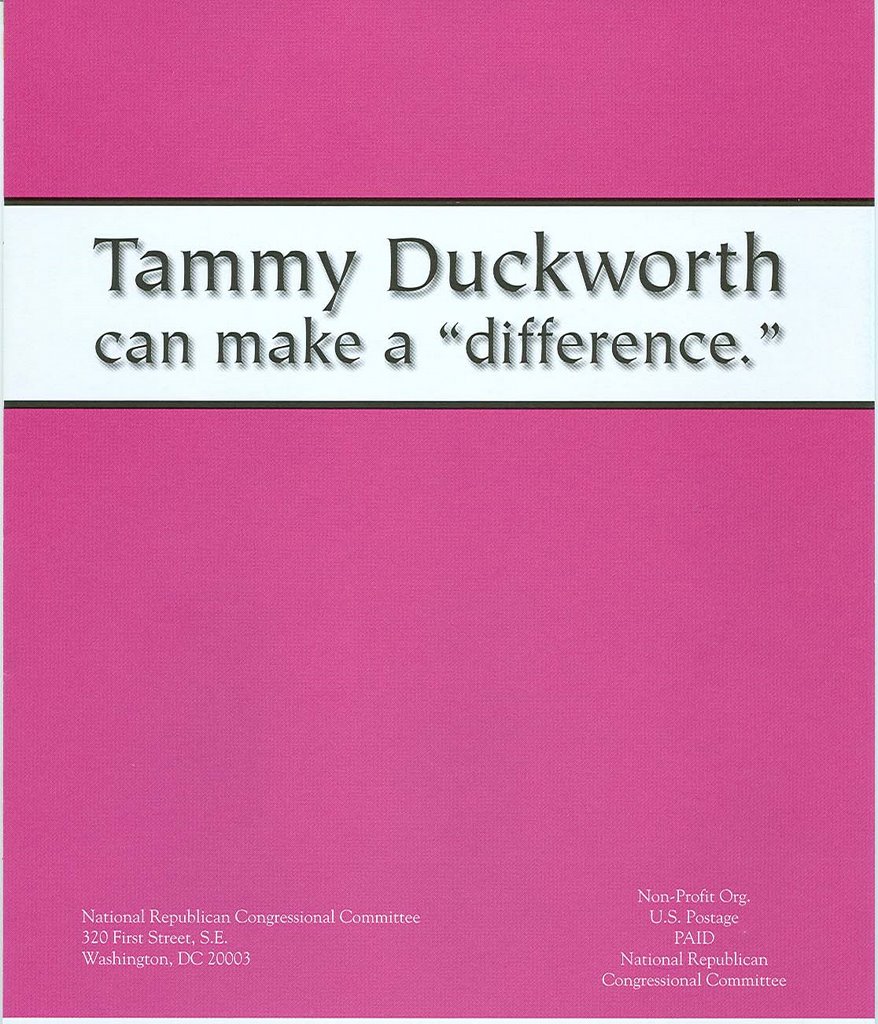
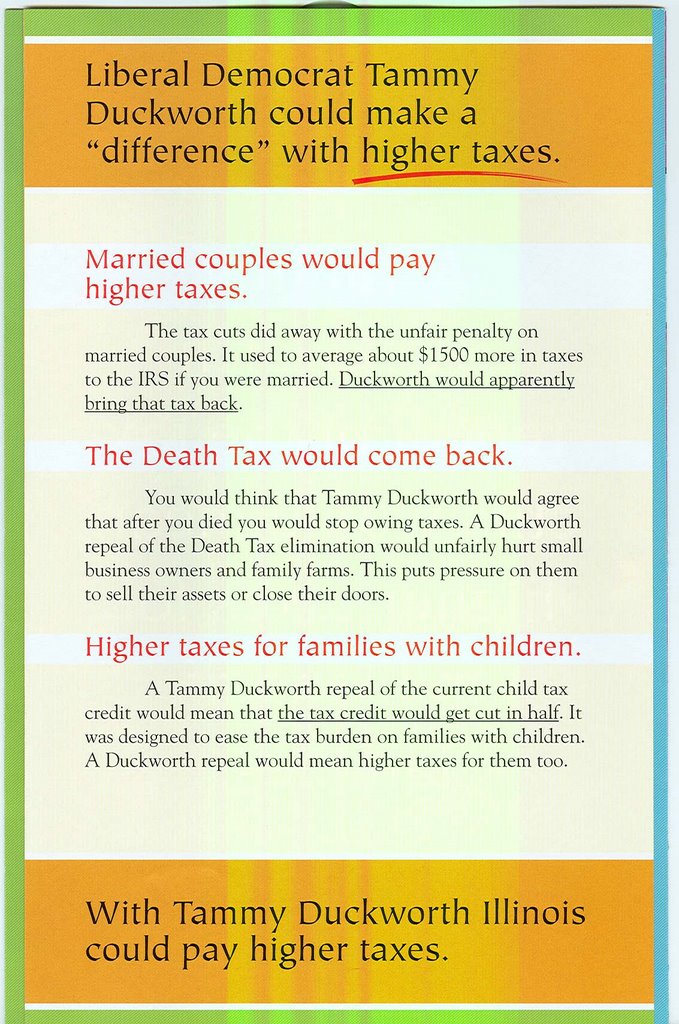
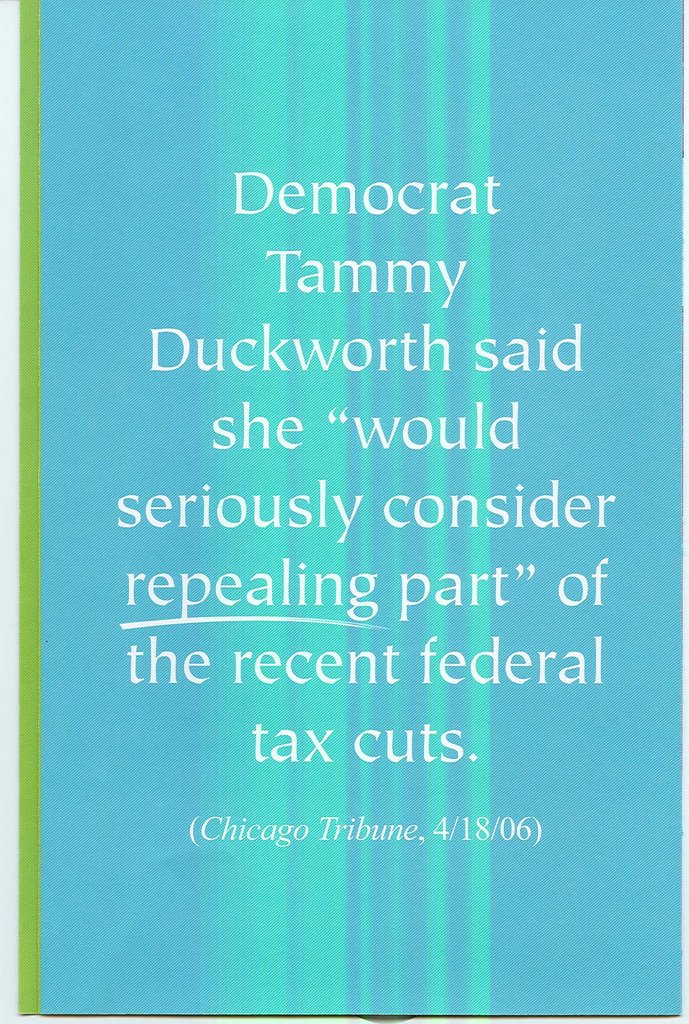
The stop in Bensenville coincided with the release of a Roskam campaign mail piece that claims Duckworth would make Illinois families pay higher taxes. The flier targets Duckworth's middling position on the Bush tax cuts, which she supports, but only in part.

Both candidates agree on the portion of the Bush plan that provide families with per-child and child care tax credits. They also agree that income tax rate cuts and the repeal of the marriage penalty should be made permanent.

Duckworth has repeatedly called for an end to tax subsidies for the oil industry and tax relief for middle-class -- but not wealthy -- families. For example, she disagrees with Roskam's position on the inheritance tax. Currently, the tax hits only those individuals with estates valued at more than $2 million.

Duckworth cites statistics that say a full repeal of the it would add more than $300 billion to the federal deficit and benefit only 8,000 U.S. families.

The exemption level is scheduled to rise to $3.5 million in 2009. At that level, only 3 of every 1,000 people who die will have an estate large enough to owe any tax, according to the Center on Budget and Policy Priorities.

"There's different ways to be fiscally responsible while helping middle-class families and reigning in the budget. The Bush administration has stood by while costs for middle-class families such as tuition, health care and costs at the fuel pump have gone up," Christine Glunz, Duckworth spokeswoman, said.

By one U.S. Treasury Department estimate, the nation is $3.5 trillion in debt and rapidly heading toward $4 trillion thanks in part to paying for the wars in Afghanistan and Iraq.

Glunz called Roskam's talk of fiscal restraint out of place considering a Republican-controlled Congress oversaw years of excessive spending.

"I think it's obvious to most people that Congress has gone from having a hefty surplus to hundreds of billions of dollars in debt ... putting our economic security at risk," she said.

Roskam acknowledged the need for spending cuts and pointed to his record in the Democrat-controlled General Assembly as evidence that he can push for them in Congress.

"What we've seen in Illinois is an economy that is simply lagging ... compared to our border states," he said. "Why is that? Because of a lack of discipline, a lack of discipline on spending on programs like All Kids. I've been a critic of (Gov. Rod Blagojevich) for three years on the Senate floor in my role as the whip."

All Kids is Blagojevich's program to provide medical insurance to children whose parents cannot afford it.

Roskam, who was joined by U.S. Rep. Phil English, R-Pa., a member of the House Ways and Means Committee, said long-term, the deficit issue will be addressed in part by the Bush tax cuts which will rev up the economy leading to increased tax revenues and improved employment and wage levels.

"Think about a company when taxes are cut. What will they typically do? They reinvest in the company," he said. "The trend line has shown us over and over again that when you cut taxes, things are dynamic and exciting and vibrant."

Copyright© 2006, Digital Chicago Inc.

http://www.pioneerlocal.com/cgi-bin/ppo-story/localnews/current/mp/08-24-06-1010755.html.printable?paper2=mp

Wednesday, August 23, 2006

The Economist:: Rahm offers some “Big Ideas for America”

Rahmbo's Plan
Aug 17th 2006
From The Economist print edition


The House Democrats' chief enforcer offers some “Big Ideas for America”

RAHM EMANUEL, a congressman from Illinois, is often compared to Newt Gingrich. The head of the Democratic Congressional Campaign Committee is clever, energetic and utterly determined to win back the House of Representatives in November. He is also, like the man who led the Republicans to just such a triumph in 1994, somewhat abrasive. He once sent a rotting fish to a pollster who irked him. When he was only 32, his aggressive fundraising helped Bill Clinton win the presidency. At a dinner afterwards, while others celebrated, he snatched up a steak knife and started plunging it into the table, naming his political enemies and yowling “Dead!” after each stab.

Some say Mr Emanuel learned to act tough to pre-empt the jeers he might otherwise have attracted as a schoolboy ballet dancer in Chicago. (He was good—his mother was apparently upset when he turned down a scholarship to the Joffrey Ballet school.) Be that as it may, his style seems to work. “Rahmbo”, as he is known, is skilled not only at squeezing money out of donors (if the pledge is too small, he lets them know), but also at making sure that the candidates who get it campaign effectively. He makes them sign agreements specifying how many appearances and fund-raising phone calls they will make. He approaches his job “with the sensibility of a Mob bookie”, gushed a profile in Rolling Stone last year.

Next week Mr Emanuel will publish his answer to Mr Gingrich's “Contract with America”, the small-government manifesto that helped Republicans capture the House in 1994. It is called “The Plan: Big Ideas for America”, and is co-written with Bruce Reed, an old chum from the Clinton White House. It has signs of being written in a hurry. Was America in the 1950s and 1960s “a land of opportunity and certainty”, as he tells us on page 31? Or has it “always been a land of opportunity, not certainty”, as he says 11 pages later? The obligatory Bush-bashing is stale and waffly: “Bush inherited the longest economic boom in history and gave the middle class the highest anxiety in memory.” But the Plan itself is solid and mostly sensible.

Probably the main reason wages have not risen much in recent years is that health-insurance premiums, which many American employers shoulder, have soared. The Plan lists ways to curb them. Doctors, rather than being paid for every test and injection they provide—an arrangement that inevitably leads to over-doctoring—should be paid by results. Patients should be given better incentives to stay healthy: insurers, for example, should push them to take free physical exams to spot ailments early. Better use of information technology could supposedly save $162 billion a year. If the system is made more efficient, Mr Emanuel thinks coverage can be extended to all American children. But he concedes that a nation as individualistic as America will probably never accept a European-style national health service—and he should know, having worked on Hillary Clinton's doomed health project in the 1990s. He argues, however, that maybe, some day, every American might receive a voucher for basic health services from the insurer of his or her choice.

Mindful of the teachers' unions, he avoids the V-word when discussing education. But he has some sensible ideas. Subsidies for those who cannot afford to go to college are currently too complex; he would replace the five main schemes with a single $3,000-a-year tax credit. Teachers should be paid for performance, not just credentials. And schoolchildren should take shorter holidays. (The Democratic Leadership Council, a moderate Clintonian body, made the same proposal last month.)

Americans are not saving enough for retirement. Well, some are. Mr Emanuel, after six years as a White House aide, earned $16m in two and a half years as an investment banker. For those who lack his quick wits and fat Rolodex, however, he proposes other ways to build up wealth. Employees should automatically be enrolled in 401(K) pension schemes unless they object. The middle class should be exempt from capital-gains tax. And families with an income of less than $100,000 a year should surrender no more than 10% of it to the taxman. As a congressman, Mr Emanuel has proved himself something of a tax wonk, co-sponsoring a plan to do to the tax code's complexities what he once fantasised about doing to his political enemies.

Perhaps the most arresting part of the Plan concerns national security, the Democrats' perennial weak spot. Again echoing Senator Clinton, he wants 100,000 more soldiers for America's overstretched army. He also wants an elite agency to fight domestic terrorism, like Britain's MI5. Of George Bush's Department of Homeland Security, he scoffs: “[It] has 180,000 employees. The London bombings in July 2005 were the work of four men with backpacks. Whose organisation chart would you rather have?” Most radically, he wants all Americans aged 18-25 to undergo three months of compulsory disaster-training.


Wouldn't it be more efficient to hire more professionals—paramedics, firemen and so forth? Not in Mr Emanuel's view. He does not want merely to prepare for future disasters; he thinks his “universal citizen service” will bring youngsters of all backgrounds together and teach them what it means to be American. “The French abandoned the idea [of national service] a decade ago, and now watch their young people riot in the streets,” he says. This is a feeble explanation for the French riots. And Mr Emanuel's scheme will remind many Americans that the Democratic Party likes social engineering more than they do.

As a whole, the Plan will help rebut the charge that the Democrats have no ideas. And if they win in November, they can always ditch the more radical parts. A Plan is less binding than a Contract, and Mr Emanuel is not the Democrats' leader in the House. At least, not yet.


Copyright © 2006 The Economist Newspaper and The Economist Group.

http://www.economist.com/displaystory.cfm?story_id=7796602

Daily Herald: Roskam Defends Federal Pork Support

Roskam defends federal pork support

By Eric Krol
Daily Herald Political Writer
Posted Tuesday, August 22, 2006

Republican congressional hopeful Peter Roskam, who’s always billed himself as a fiscal conservative, tried to walk a political tightrope Monday by embracing an oft-criticized budget tactic for securing federal funding for local projects.

The 6th Congressional District GOP nominee said he’d support continuing the so-called practice of “earmarks” if elected to Congress to make sure projects like fixing the dangerous railroad crossing at Irving Park and Wood Dale roads continue to get funded.

“I don’t think we should leave it to a bureaucrat in Washington, D.C., who’s in a gray building and goes to sleep in the suburbs of Virginia every night and has never been to Wood Dale making fundamental decisions about the life and health and safety of Wood Dale,” said Roskam at Wood Dale city hall.

Democratic opponent Tammy Duckworth has vowed to end earmarks, calling the practice wasteful and corrupt in an era of record budget deficits. Duckworth’s campaign, which puts out a news release every week highlighting pork projects, criticized Roskam.

“He’ll continue more of the same in Congress,” Duckworth spokeswoman Christine Glunz said. “He’s trying to defend himself on an issue he’s clearly weak on.”

When asked how Duckworth would bring home the proverbial bacon for the 6th District, Glunz said projects like the railroad crossing would get funded on merit.

Roskam said he would back a change to make earmarks more transparent, requiring the sponsoring congressman’s name to be listed.

The Wood Dale intersection has had 128 crashes in three years, making it the most accident-prone railroad crossing in Illinois. Retiring Congressman Henry Hyde has secured $11 million to create an underpass, but the project costs $65 million, officials said.

Physician Lanny Wilson, who lost his 14-year-old daughter Lauren in a 1994 accident at a Hinsdale crossing when his son tried to outrun a train by going around the crossing gates, said it’s crucial the project be completed.

In other 6th District race news, the National Republican Campaign Committee recently reserved $2.3 million worth of TV ad time for the final weeks before the Nov. 7 election. The move matches an earlier Democratic Congressional Campaign Committee reservation of $2.3 million of campaign time. If history holds, both parties will spend that money to air negative attack ads about the other party’s candidate.

http://www.dailyherald.com/search/searchstory.asp?id=218930

And the Amazing Technicolor Mailer


Saturday, August 19, 2006

More DeLay Ties for Roskam

Congressional race starts getting nasty
http://www.dailyherald.com/news/illinoisstory.asp?id=217841


Posted Friday, August 18, 2006

The first bit of political nastiness in the 6th Congressional District race surfaced Thursday about the ethical pasts of key campaign staff for both Republican Peter Roskam and Democrat Tammy Duckworth.

The Duckworth campaign initially criticized Roskam for allowing the national GOP to send in veteran operative Jason Roe, pointing to his past work for indicted ex-House Majority Leader Tom DeLay of Texas and involvement in an ethics investigation about a prescription drug vote.

“I think it’s clear that the alarm bells have gone off about Peter Roskam’s campaign,” Duckworth spokeswoman Christine Glunz said. “Sending in someone who has ties to Tom DeLay as well as someone who is doing dirty work, strong-arming and twisting arms on the Medicare bill.”

But the National Republican Campaign Committee was able to boomerang the ethics rap on Roe back at Duckworth, pointing out that her campaign manager, Jon Carson, was granted immunity as part of a 2001 probe into political corruption involving a prominent Wisconsin Democrat.

Jonathan Collegio, a spokesman for the National Republican Campaign Committee, called the Duckworth campaign’s criticisms “stunningly hypocritical.”

“(Duckworth) has resorted to Chicago Democrat machine-style mudslinging and dirty tricks,” Collegio said.

The charges and counter-charges amounted to “your campaign worker has more ethical baggage than our campaign worker.”

Roe worked three weeks on DeLay’s 2004 re-election campaign helping with get-out-the-vote efforts. DeLay since has lost his majority leader position amid scandal, but Roe is not involved in that.

Also, a 2004 House ethics report shows Nick Smith, then a Michigan congressman, testified that Roe told him his son who was running to succeed him could receive “substantial support” if the elder Smith voted for the federal prescription drug plan. Roe pointed out the report clears him of any wrongdoing and said he only was responding to Smith’s question about the ramifications of a vote.

Carson briefly worked as the No. 2 staff member for then-Wisconsin Senate Democratic leader Chuck Chvala, who was eventually sentenced to nine months for political corruption. Carson, who was not accused of any wrongdoing, was granted immunity from prosecution and paid his own legal bills.

Wednesday, May 17, 2006

From: Think Progress

Big Oil Launches Attack On Al Gore

By Faiz on Radical Right-Wing Agenda

Today, the Competitive Enterprise Institute (CEI) will unveil two 60-second TV ads focusing on what it calls “global warming alarmism and the call by some environmental groups and politicians to reduce fossil fuel and carbon dioxide emissions.” The ad, which will be aired in more than a dozen cities across the country, is being released just a week before the May 24th opening (in LA and NYC) of Al Gore’s new movie on global warming, An Inconvenient Truth.

Who is CEI? The Washington Post explains:

The Competitive Enterprise Institute, which widely publicizes its belief that the earth is not warming cataclysmically because of the burning of coal and oil, says Exxon Mobil Corp. is a “major donor” largely as a result of its effort to push that position.

CEI also gets funding from other oil companies through the American Petroleum Institute.

Exxon documents reveal the company gave $270,000 to CEI in 2004 alone. $180,000 of that was earmarked for “global climate change and global climate change outreach.” Exxon has contributed over $1.6 million to CEI since 1998.

CEI’s general counsel Sam Kazman said, “I think what attracted [Exxon] to us was our position on global warming.” CEI’s position? The Institute believes the dangers of global warming are akin “to that of ‘an alien invasion.’”

Exxon’s spokesperson Tom Cirigliano has explained why the company is so dedicated to funding CEI’s pushback on global warming:

We want to support organizations that are trying to broaden the debate. … There is this whole issue that no one should question the science of global climate change that is ludicrous. That’s the kind of dark-ages thinking that gets you in a lot of trouble.

The science is not questioned because the science behind global warming is indisputable. Science Magazine analyzed 928 peer-reviewed scientific papers on global warming published between 1993 and 2003. Not a single one challenged the scientific consensus that the earth’s temperature is rising due to human activity. The U.S. Climate Change Science Program concluded that humans are driving the warming trend through greenhouse gas emissions. And the EPA has said that the recent warming trend “is real and has been particularly strong within the past 20 years…due mostly to human activities.”

For the oil industry, Al Gore’s film exposing the truth is perceived as a threat, and they have no shortage of funds to try to distort it.

Tuesday, April 11, 2006

Chicago Tribune: Apartment shortages squeeze young, poor; As units dwindle, rents march higher

From your March 9, 2006 Chicago Tribune:
Apartment shortages squeeze young, poor;
As units dwindle, rents march higher

LaDonna Dennis and her 9-year-old son want to live in a safe neighborhood on the South Side. But to do that, she may have to spend more than half of her $1,400-a-month income on rent.

The 48-year-old single mother, like many other renters in Chicago and across the country, faces dramatically higher rents as the housing boom has swept away old buildings and turned others into expensive condominiums.

Cook County is losing about 3,400 rental units each year, part of 200,000 units disappearing annually across the country. The shortage was outlined Wednesday in the first comprehensive study of the U.S. rental housing market by Harvard University's Joint Center for Housing Studies. It was sponsored by the John D. and Catherine T. MacArthur Foundation in Chicago.

Nationally, about 2 million apartments--more than 6 percent of the rental stock--were lost between 1993 and 2003, the last full year for which numbers are available.

The loss of affordable rentals is putting pressure on groups of people who can least afford to cope with the increased costs: the young and the poor.

Some 34 million households, about one-third of the nation's total, live in rental units, a fact overshadowed in recent years by the housing boom.

"We are taking one step forward and two steps back as gentrification in some neighborhoods and continued deterioration in others leads to the removal of vitally needed lower-cost rental housing," said Joint Center director Nicolas Retsinas.

In the downtown Chicago market alone, 2005 was the biggest conversion year in 25 years, according to Appraisal Research Counselors of Chicago, which only tracks buildings of 25 units or more. More than 3,800 units were converted to condos last year.

John Bartlett, executive director of Chicago's Metropolitan Tenants Organization, said the condo conversions are a "serious problem" in the city as once-affordable apartments are "turned into places that people cannot afford."

Two years ago, "there used to be lots of apartments you could find for $700," Bartlett said, "and now that's non-existent. Some of the places along the lake, they're going to be $1,200 to $1,400 for a one-bedroom apartment."

Bartlett estimated that the average price for a one-bedroom in Chicago now is about $1,100, with the average two-bedroom nearly $1,800. That's "completely out of reach. For a low-income renter, there is going to have to be some kind of subsidy" to afford it, he said.

The problem varies by neighborhood, but Bartlett's group increasingly is getting calls from people who can't afford the rent in places such as Rogers Park and the South Side's 4th and 5th Wards. "Even in the 28th Ward [West Side]--we are getting way more calls than we ever did," in an area that used to have a high density of rentals.

"Those kinds of low rentals are needed," Bartlett said. A person would need to earn about $30,000 a year to afford the current average rent, he said.

"People making minimum wage" can't do it, he said, adding that his group is seeing more doubling up of family members in one apartment, and more friends moving in together. "People can't afford to live on their own."

Garth Taylor, president of the Metro Chicago Information Center, a policy research center, said about 308,000 of the local households renting are considered rent-burdened, which means they spend 30 percent or more of household income on rent. Nearly 62,000 households are severely rent-burdened, which means more than 50 percent of income goes to rent.

Consider Dennis. She pays $500 a month, or roughly a third of her monthly income, for a two-bedroom unit in a six-flat building in the South Shore neighborhood.

Since January, the hospital worker has narrowed her search to the South Side neighborhoods of Bronzeville, North Kenwood and Woodlawn, where public housing complexes have been redeveloped into mixed-income developments. She's on a long waiting list for a new Bronzeville unit near her church.

"They've torn down a lot of Chicago public housing and they are rebuilding for mixed-income. The rents are running like $850 for two-bedrooms and $1,000 for three-bedrooms," said Dennis. "If I could find a two-bedroom for $850, I'd be happy."

Cook County has an estimated 748,000 rental units, about 39 percent of the county's housing, according to Chicago Metropolis 2020, a business-sponsored think tank that studies regional issues. This is down from 831,400 in 2000.

And by 2009, 32,000 rental units with government subsidies in Cook County are at risk as government supports expire.

Eighty percent of all households 25 years or under are renters and two-thirds of households ages 25 to 29 live in apartments, the Harvard study reported.

Median listed rent for new-construction buildings rose from $734 in 1994 to $974 in 2004. During the same period, monthly renter income rose from $2,272 to $2,348.

Illinois and the Chicago area may be especially vulnerable to those pressures, noted Frank Beal, executive director of Chicago Metropolis 2020.

The Chicago area is consistently falling behind the rest of the country in building new rentals, Beal said. The Cook County tax codes are unfavorable for large rental buildings and Illinois laws are favorable to conversions, he said. In addition, the region has 272 municipalities, which can keep out rental buildings if officials deem it in the interest of the town.

Monday, February 27, 2006

Tribune 2004 Endorsements

The Tribune's endorsements
Chicago Tribune
November 2, 2004


These are the Chicago Tribune editorial board's endorsements in Tuesday's elections.

Endorsements are made only in contested races.

NATIONAL OFFICES

U.S. PRESIDENT

George W. Bush (R)

U.S. SENATE

Barack Obama (D)

U.S. HOUSE

1st District

Bobby Rush (D)

2nd District

Jesse Jackson Jr. (D)

3rd District

Daniel Lipinski (D)

4th District

Luis Gutierrez (D)

5th District

Rahm Emanuel (D)

6th District

Henry Hyde (R)


7th District

Danny Davis (D

8th District

Melissa Bean (D)

9th District

Jan Schakowsky (D)

10th District

Mark Kirk (R)

11th District

Jerry Weller (R)

12th District

Erin Zweigart (R)

13th District

Judy Biggert (R)

14th District

Dennis Hastert (R)

15th District

Tim Johnson (R)

16th District

Donald Manzullo (R)

17th District

No endorsement

18th District

Ray LaHood (R)

19th District

John Shimkus (R)

STATE OFFICES

ILLINOIS SENATE

5th District

Rickey Hendon (D)

8th District

Ira Silverstein (D)

11th District

Louis Viverito (D)

26th District

Bill Peterson (R)

29th District

Susan Garrett (D)

32nd District

Pamela Althoff (R)

35th District

Brad Burzynski (R)

38th District

Gary Dahl (R)

47th District

John Sullivan (D)

56th District

Bill Haine (D)

59th District

Ron Summers (R)

ILLINOIS HOUSE

5th District

Ken Dunkin (D)

8th District

Julie Samuels (Green)

10th District

Annazette Collins (D)

11th District

John Fritchey (D)

12th District

Sara Feigenholtz (D)

15th District

William Miceli (R)

16th District

Lou Lang (D)

17th District

Elizabeth Coulson (R)

18th District

Julie Hamos (D)

19th District

Joseph Lyons (D)

20th District

Michael McAuliffe (R)

21st District

Robert Molaro (D)

22nd District

Michael Madigan (D)

24th District

No endorsement

28th District

Michael Fredette (R)

35th District

Kevin Joyce (D)

36th District

James Brosnahan (D)

38th District

Robin Kelly (D)

40th District

Richard Bradley (D)

43rd District

Ruth Munson (R)

46th District

Lee Daniels (R)

47th District

Patti Bellock (R)

48th District

Guy Rosenthal (D)

50th District

Patricia Reid Lindner (R)

51st District

Ed Sullivan Jr. (R)

52nd District

Mark Beaubien (R)

53rd District

Sidney Mathias (R)

57th District

Elaine Nekritz (D)

58th District

Karen May (D)

59th District

Kathleen Ryg (D)

60th District

Eddie Washington (D)

61st District

JoAnn Osmond (R)

62nd District

Sharyn Elman (D)

63rd District

Perry Moy (R)

64th District

Michael Tryon (R)

65th District

Rosemary Mulligan (R)

68th District

Dave Winters (R)

70th District

Robert Pritchard (R)

71st District

Steve Haring (R)

72nd District

Patrick Verschoore (D)

74th District

Donald Moffitt (R)

75th District

Doug Hayse (R)

79th District

Kay Pangle (R)

82nd District

Eileen Lyons (R)

85th District

Brent Hassert (R)

88th District

Dan Brady (R)

92nd District

Aaron Schock (R)

95th District

Randall Hultgren (R)

99th District

Raymond Poe (R)

101st District

Robert Flider (D)

103rd District

Deborah Frank Feinen (R)

106th District

Keith Sommer (R)

107th District

Kurt Granberg (D)

108th District

David Reis (R)

109th District

Roger Eddy (R)

111th District

Steve Davis (D)

114th District

Wyvetter Younge (D)

115th District

Mike Bost (R)

117th District

John Bradley (D)

STATE COURTS

ILLINOIS SUPREME COURT

5th District

Lloyd A. Karmeier (R)

ILLINOIS APPELLATE COURT

3rd District

Jim Wright (R)

ILLINOIS APPELLATE COURT -- RETENTION JUDGES

Vote "YES" for the following:

1st District

Thomas Hoffman

Sheila O'Brien

Mary Jane Wendt Theis

2nd District

Susan Fayette Hutchinson

3rd District

William Holdridge

Endorsements in the collar counties

These are the Chicago Tribune's endorsements in Tuesday's elections for races in Cook, DuPage, Kane, McHenry, Will and Lake Counties:

COOK COUNTY

COOK COUNTY STATE'S ATTORNEY

Richard Devine (D)

COOK COUNTY RECORDER

John Cox (R)

COOK COUNTY CLERK OF THE CIRCUIT COURT

Dorothy Brown (D)

METROPOLITAN WATER RECLAMATION DIST.

Patricia Young (D)

Gloria Alitto Majewski (D)

Barbara McGowan (D)

COOK COUNTY CIRCUIT COURT

Salyers vacancy

Michelle Jordan (D)

COOK COUNTY COURT SUBCIRCUITS

4A

Bill Kunkle (R)

12

Kay Marie Hanlon (R)

15

Catherine Sanders (R)

COOK COUNTY CIRCUIT COURT -- RETENTION JUDGES

The Tribune recommends a "YES" vote for the judges seeking retention, with the following exceptions. On these judges, the Tribune recommends a "NO" vote:

Dorothy Jones

Susan McDunn

William O'Neal

DUPAGE COUNTY

DUPAGE COUNTY BOARD

1st District

Paul Fichtner (R)

2nd District

Patrick O'Shea (R)

3rd District

Richard Moss (D)

4th District

Debra Olson (R)

5th District

Hiram Wurf (D)

6th District

Pamela Rion (R)

DUPAGE COUNTY FOREST PRESERVE COMMISSION

1st District

Marsha Murphy (R)

3rd District

Wallace Brown (R)

5th District

Carl Schultz (R)

DUPAGE CO. CLERK OF THE CIRCUIT COURT

Chris Kachiroubas (R)

DUPAGE COUNTY CORONER

Peter Siekmann (R)

18TH JUDICIAL CIRCUIT COURT -- RETENTION JUDGES

Vote "YES" for the following judges:

Bonnie Wheaton

Robert Emmett Byrne

Robert K. Kilander

Rodney Equi

KANE COUNTY

KANE COUNTY BOARD

2nd District

Mary Richards (R)

4th District

Penelope Cameron (R)

10th District

Thomas Van Cleave (R)

14th District

Elaine Stern (D)

20th District

Marlena Fox (D)

22nd District

Jackie Tredup (R)

24th District

Margaret Scalfaro (R)

KANE COUNTY BOARD CHAIRMAN

Karen McConnaughay (R)

KANE COUNTY CORONER

Charles West (R)

KANE COUNTY RECORDER

Sandy Wegman (R)

KANE COUNTY STATE'S ATTORNEY

John Barsanti (R)

16TH JUDICIAL CIRCUIT COURT

Jensen vacancy

Robert Spence (R)

Vote "YES" for the following retention judges:

James Doyle Donald Fabian

LAKE COUNTY

LAKE COUNTY BOARD

1st District

Judy Martini (R)

5th District

Bonnie Thomson Carter (R)

6th District

Lawrence Leafblad (R)

10th District

Diana O'Kelly (R)

11th District

Sandy Cole (R)

16th District

Robert Powers (R)

LAKE COUNTY CLERK

Sally Coffelt (R)

LAKE COUNTY CORONER

Richard Keller (D)

LAKE COUNTY RECORDER

Mary Ellen Vanderventer (D)

LAKE COUNTY STATE'S ATTORNEY

Michael Waller (R)

NORTH SHORE SANITARY DISTRICT

Daniel Pierce (D)

19TH JUDICIAL CIRCUIT COURT -- RETENTION JUDGES

Vote "YES" for the following:

Raymond McKoski

Henry Tonigan

Margaret Mullen

McHENRY COUNTY

McHENRYCOUNTY BOARD

1st District

Dan Shea (R)

Marc Munaretto (R)

2nd District

Marie Chmiel (R)

Lori Keller (D)

3rd District

Ann Kate (R)

Nick Provenzano (R)

4th District

John Hammerand (R)

Sue Draffkorn (R)

5th District

Virginia Peschke (R)

John Jung Jr. (R)

6th District

Richard Klasen (R)

Mary Lou Zierer (R)

WILL COUNTY

WILL COUNTY BOARD

1st District

Lee Deutsche (D)

Mary Ann Gearhart Deutsche (R)

Cory Singer (R)

2nd District

Thomas Weigel (R)

6th District

Don Gould (R)

Kerry Sheridan (R)

Deborah Rozak (R)

7th District

Kathleen Konicki (R)

Ronald Svara (R)

Jim Bilotta (R)

9th District

Stephen Wilhelmi (D)

WILL COUNTY CIRCUIT CLERK

Pamela McGuire (D)

WILL COUNTY RECORDER

Laurie McPhillips (R)

WILL COUNTY STATE'S ATTORNEY

James Glasgow (D)

WILL COUNTY AUDITOR

Steve Weber (R)

WILL COUNTY CORONER

Patrick O'Neil (D)

WILL COUNTY CHIEF EXECUTIVE OFFICER

Joseph Mikan (R)

The Tribune's endorsements, Chi. Trib., November 2, 2004, § 1, at 20.

Chicago Tribune: George W. Bush for President

Chicago Tribune Editorial
George W. Bush for president

October 17, 2004

One by one, Americans typically settle on a presidential candidate after weighing his, and his rival's, views on the mosaic of issues that each of us finds important.

Some years, though, force vectors we didn't anticipate turn some of our usual priorities--our pet causes, our own economic interest--into narcissistic luxuries. As Election Day nears, the new force vectors drive our decision-making.

This is one of those years--distinct in ways best framed by Sen. John McCain, perhaps this country's most broadly respected politician. Seven weeks ago, McCain looked with chilling calm into TV cameras and told Americans, with our rich diversity of clashing worldviews, what is at stake for every one of us in the first presidential election since Sept. 11 of 2001:

"So it is, whether we wished it or not, that we have come to the test of our generation, to our rendezvous with destiny. ... All of us, despite the differences that enliven our politics, are united in the one big idea that freedom is our birthright and its defense is always our first responsibility. All other responsibilities come second." If we waver, McCain said, "we will fail the one mission no American generation has ever failed--to provide to our children a stronger, better country than the one we were blessed to inherit."

This year, each of us has the privilege of choosing between two major-party candidates whose integrity, intentions and abilities are exemplary.

One of those candidates, Sen. John Kerry, embraces an ongoing struggle against murderous terrorists, although with limited U.S. entanglements overseas. The other candidate, President George W. Bush, talks more freely about what is at risk for this country: the cold-eyed possibility that fresh attacks no better coordinated than those of Sept. 11--but with far deadlier weapons--could ravage American metropolises. Bush, then, embraces a bolder struggle not only with those who sow terror, but also with rogue governments that harbor, finance or arm them.

This was a radical strategy when the president articulated it in 2001, even as dust carrying the DNA of innocents wafted up from ground zero. And it is the unambiguous strategy that, as this page repeatedly has contended, is most likely to deliver the more secure future that John McCain wishes for our children.

A President Kerry certainly would punish those who want us dead. As he pledged, with cautiously calibrated words, in accepting his party's nomination: "Any attack will be met with a swift and certain response." Bush, by contrast, insists on taking the fight to terrorists, depriving them of oxygen by encouraging free and democratic governments in tough neighborhoods. As he stated in his National Security Strategy in 2002: "The United States can no longer solely rely on a reactive posture as we have in the past. ... We cannot let our enemies strike first."

Bush's sense of a president's duty to defend America is wider in scope than Kerry's, more ambitious in its tactics, more prone, frankly, to yield both casualties and lasting results. This is the stark difference on which American voters should choose a president.

There is much the current president could have done differently over the last four years. There are lessons he needs to have learned. And there are reasons--apart from the global perils likely to dominate the next presidency--to recommend either of these two good candidates.

But for his resoluteness on the defining challenge of our age--a resoluteness John Kerry has not been able to demonstrate--the Chicago Tribune urges the re-election of George W. Bush as president of the United States.

- - -

Bush, his critics say, displays an arrogance that turns friends into foes. Spurned at the United Nations by "Old Europe"--France, Germany, Russia--he was too long in admitting he wanted their help in a war. He needs to acknowledge that his country's future interests are best served by fixing frayed friendships. And if re-elected, he needs to accomplish that goal.

But that is not the whole story. Consider:

Bush has nurtured newer alliances with many nations such as Poland, Romania and Ukraine (combined population, close to 110 million) that want more than to be America's friends: Having seized their liberty from tyrants, they are determined now to be on the right side of history.

Kerry is an internationalist, a man of conspicuous intellect. He is a keen student of world affairs and their impact at home.

But that is not the whole story. Consider:

On the most crucial issue of our time, Kerry has serially dodged for political advantage. Through much of the 2004 election cycle, he used his status as a war hero as an excuse not to have a coherent position on America's national security. Even now, when Kerry grasps a microphone, it can be difficult to fathom who is speaking--the war hero, or the anti-war hero.

Kerry displays great faith in diplomacy as the way to solve virtually all problems. Diplomatic solutions should always be the goal. Yet that principle would be more compelling if the world had a better record of confronting true crises, whether proffered by the nuclear-crazed ayatollahs of Iran, the dark eccentrics of North Korea, the genocidal murderers of villagers in Sudan--or the Butcher of Baghdad.

In each of these cases, Bush has pursued multilateral strategies. In Iraq, when the UN refused to enforce its 17th stern resolution--the more we learn about the UN's corrupt Oil-for-Food program, the more it's clear the fix was in--Bush acted. He thus reminded many of the world's governments why they dislike conservative and stubborn U.S. presidents (see Reagan, Ronald).

Bush has scored a great success in Afghanistan--not only by ousting the Taliban regime and nurturing a new democracy, but also by ignoring the chronic doubters who said a war there would be a quagmire. He and his administration provoked Libya to surrender its weapons program, turned Pakistan into an ally against terrorists (something Bill Clinton's diplomats couldn't do) and helped shut down A.Q. Khan, the world's most menacing rogue nuclear proliferator.

Many of these cross-currents in Bush's and Kerry's worldviews collide in Iraq.

Bush arguably invaded with too few allies and not enough troops. He will go to his tomb defending his reliance on intelligence from agencies around the globe that turned out to be wrong. And he has refused to admit any errors.

Kerry, though, has lost his way. The now-professed anti-war candidate says he still would vote to authorize the war he didn't vote to finance. He used the presidential debates to telegraph a policy of withdrawal. His Iraq plan essentially is Bush's plan. All of which perplexes many.

Worse, it plainly perplexes Kerry. ("I do believe Saddam Hussein was a threat," he said Oct. 8, adding that Bush was preoccupied with Iraq, "where there wasn't a threat.") What's not debatable is that Kerry did nothing to oppose White House policy on Iraq until he trailed the dovish Howard Dean in the race for his party's nomination. Also haunting Kerry: his Senate vote against the Persian Gulf war--driven by faith that, yes, more diplomacy could end Saddam Hussein's rape of Kuwait.

- - -

On domestic issues, the choice is also clear. In critical areas such as public education and health care, Bush's emphasis is on greater competition. His No Child Left Behind Act has flaws, but its requirements have created a new climate of expectation and accountability. On both of these important fronts, but especially with his expensive health-care plan, Kerry primarily sees a need to raise and spend more money.

The failure of either candidate to offer spending and taxation proposals that remotely approach balancing the federal budget is an embarrassment to both. The non-partisan Concord Coalition calculates the 10-year impact of Bush's proposals as a negative $1.33 trillion; the impact of Kerry's is a nearly identical $1.27 trillion. Kerry correctly cites the disturbingly expensive legacy of Bush's tax cuts--while, in the same breath, promising new tax cuts of his own.

This is a genre of American fiction that Bush, if he is re-elected, cannot perpetuate. To Bush's credit, his tax policies have had the aggregate effect of pushing Americans toward more savings and investment--the capital with which the world's strongest economy generates jobs. But he has not shown the necessary discipline on discretionary spending. Two particularly egregious examples: Medicare prescription drug coverage and an enormously expensive farm subsidy bill, both signed by Bush.

This country's paramount issue, though, remains the threat to its national security.

John Kerry has been a discerning critic of where Bush has erred. But Kerry's message--a more restrained assault on global threats, earnest comfort with the international community's noble inaction--suggests what many voters sense: After 20 years in the Senate, the moral certitude Kerry once displayed has evaporated. There is no landmark Kennedy-Kerry Education Act, no Kerry-Frist Health Bill. Today's Kerry is more about plans and process than solutions. He is better suited to analysis than to action. He has not delivered a compelling blueprint for change.

For three years, Bush has kept Americans, and their government, focused--effectively--on this nation's security. The experience, dating from Sept. 11, 2001, has readied him for the next four years, a period that could prove as pivotal in this nation's history as were the four years of World War II.

That demonstrated ability, and that crucible of experience, argue for the re-election of President George W. Bush. He has the steadfastness, and the strength, to execute the one mission no American generation has ever failed.

Copyright © 2006, Chicago Tribune
http://www.chicagotribune.com/news/specials/elections/chi-0410170332oct17,1,1802792.story?coll=chi-navrailnews-nav

Saturday, February 25, 2006

Alexander Cockburn: Rahm's Candidates Fence-Straddle on the War

beat the devil by Alexander Cockburn

http://www.thenation.com/doc/20060109/cockburn

The Year of Vanished Credibility

[from the January 9, 2006 issue]

Start with Bush. Never at ease before the cameras, he now has the hunted blink and compulsive nasolabial twitch of the mad dictator, a cornered rat with nowhere left to run. Nixon looked the same in his last White House days, and so did Hitler, according to those present in the Führerbunker. As Hitler did before him, Bush raves on about imagined victories. Spare a thought for the First Lady, who has to endure his demented and possibly drunken harangues over supper. The word around Washington is that he's drinking again. At this rate he'll be shooting the dog and ordering the First Lady to take poison, which I'm sure she'll have great pleasure in forwarding to her mother-in-law.

Certainly it's hard to escape Bush's voice. Every time I turn on the radio, there he is giving a press conference, or yet another bulletin on the great triumphs in Iraq (where the recent election produced utter defeat for the United States and total victory for Iran). There's talk of a Bush bounce in the polls, though I tend to believe the usually reliable Zogby poll, which found on December 13 that after edging back up above 40 percent in November, Bush's job approval rating was once again at 38 percent. I'm sure millions of Americans yearn to approve of Bush. He's officially scheduled to be in the White House for another three years, and who wants a lemon in the garage that long? And indeed, the President does still have his die-hard fans, clustered in their places of worship in the remoter regions of the country. A mid-November poll by SurveyUSA found that in only seven states did Bush's current approval rating even hover around 50 percent. These consisted of thinly populated states where sexual relations with livestock are still commonplace: Utah, Idaho, Wyoming, Nebraska, Oklahoma, Alabama and Mississippi.

All the same, we've mishandled the situation. When Bush landed on the aircraft carrier and said, Mission accomplished, we all sneered. Wrong move. We should have applauded and said, Now leave! Same thing when there turned out to be no weapons of mass destruction in Iraq. We sneered again. We should have said, Great! America's safe. Let's quit while we're ahead.

Now Bush is saying that the job will be done when Iraqis enjoy the democratic freedoms guaranteed Americans. We should say, They do! Bought news stories; secret surveillance of phone calls, e-mails and faxes; arrest without warrant; disappearances; torture--you've brought our democracies into sync. Call it a day, bring the troops home and then we can start impeaching you.

But who would do the impeaching? The Democrats have lost as much credibility as the President and the Republicans. Ever since the New York Times loitered a year late into print with its disclosure about the NSA spying program (only the latest in a sequence of unconstitutional infamies by that agency stretching back for decades, mostly against domestic political protesters), I've seen it argued that if the Times had gone with the story last year, Kerry might be President.

But if the Democrats had cared about the Constitution, they could have broken the story last year. Democratic Congressional leaders knew, because the whistleblowers from the NSA desperately tried to alert them, only to get the cold shoulder. Kerry's prime advisers on such matters--Richard Clarke and Rand Beers--knew, because they'd previously been Bush's top functionaries in the "war on terror."

We're heading into a year when the Democrats could be making hay by actually doing the right thing. If 2005 is a pointer, they never will. The latest evidence is that Rahm Emanuel, in charge of selecting Democratic Congressional candidates for 2006, is choosing millionaires and fence-straddlers on the war. He shunned Christine Cegelis, who nearly beat sixteen-termer Henry Hyde in 2004, and whom Illinois polls show to be a popular contender to succeed Hyde. But Cegelis has the disadvantage in Emanuel's eyes of not being very rich and of agreeing with John Murtha on immediate withdrawal of US troops from Iraq. So Emanuel picked Tammy Duckworth, who embodies the cynicism of the "Democratic strategists," being a double-amputee woman Iraq veteran who is not from the district, has a hot-air position on the war and is thought to espouse a "pro-business/centrist platform."

For years Democrats have been dreaming of having a bluff, no-nonsense type, preferably draped in medals, to lead them into political battle. They picked a clunker last year, in the form of Kerry, who had a glass jaw, six houses, a silly billionaire wife and an infinite capacity for talking out of both sides of his mouth. Along comes Murtha, once a Marine drill instructor at Parris Island, who is showing how to talk about the war, how to say it's quitting time. And they flee him like a poisoned thing.

I watched Murtha put Bush away last Sunday. It was effortless.

WOLF BLITZER: Here's what the President said this past week....He seemed to be addressing you specifically...
BUSH: Setting an artificial deadline would send the wrong message to our most important audience, our troops on the front line. It would tell them that America is abandoning the mission they are risking their lives to achieve and that the sacrifice of their comrades killed in this struggle has been in vain.
MURTHA: This is a real war; this is not a war of rhetoric. What the troops get disappointed [about] is they don't have the equipment they need.... I found a shortage of 40,000 battle jackets that they didn't have. That's the thing that demoralizes them. And they know they're targets. I was out at the hospital the other day, and I talked to a young woman whose husband had been to Iraq twice, wounded very badly, lying there in a hospital bed. She says, You know, he enlisted to fight for America, not for Iraq. The Iraqis have to do this themselves. That's the answer to this whole situation.

So that's it for 2005: no credibility for the President, or for the Democrats, or for the New York Times, which took a year to figure out whether the Constitution is worth fighting for. 2006 should be an exciting year. Let's welcome it in.

http://www.thenation.com/doc/20060109/cockburn

About Me

My photo
"Austin Mayor" is not a real name. "Austin Mayor" is not a title. "Austin Mayor" is a pseudonym. "Austin Mayor" is a simulacrum. "Austin Mayor" is performance art. "Austin Mayor" is a brand without a product. "Austin Mayor" is your imaginary friend.