"Barack Obama Inc.: The birth of a Washington Machine"
reprinted from Harpers Magazine
by: Ken Silverstein
In July, on a typically oppressive summer day in Washington, D.C., roughly a thousand college students from across the country gathered at a Marriot hotel with plans to change the world. Despite being sponsored by the Center for American Progress, a moderate think tank founded by one of Bill Clinton's former chiefs of staff, John Podesta, the student group -- called Campus Progress -- leans decidedly farther to the left. At booths outside the main auditorium, young activists handed out pamphlets opposing nuclear power, high pay for CEOs, excessive profits for oil companies, harsh prison sentences for drug users, and Israeli militarism in Gaza and the West Bank. At one session, Adrienne Maree Brown of The Ruckus Society--a protest group whose capacious mission is to promote "the voices and visions of youth, women, people of color, indigenous people and immigrants, poor and working class people, lesbian, gay, bisexual, gender queer, and transgendered people"--urged students to "break the fucking rules." Even the consummate insider Podesta told attendees, with unintended ambiguity, "We need more of you hanging from trees."
Around noon, conference participants began filing into the auditorium; activists staffing the literature booths abandoned their posts to take seats inside as well. The crowd, and the excitement, building in the hall was due entirely to the imminent arrival of the keynote speaker: Illinois Senator Barack Obama. Having ascended to political fame through a stirring and widely lauded speech at the 2004 Democratic Convention, Obama, the U.S. Senate's only African-American member, is now considered to be the party's most promising young leader-especially among those who, like the student organizers present, are seeking to reinvigorate its progressive wing. In terms of sheer charisma, Obama is certainly the party's most magnetic leader since Bill Clinton, and perhaps since Robert F. Kennedy.
The senator was running a bit late; but when he finally glided into the auditorium, escorted by an assortment of aides, he was greeted by a tremendous swell of applause as he took to the stage. Dressed in a brown jacket and red tie, Obama approached the podium, flanked by two giant screens enlarging his image, and began a softly spoken but compelling speech that recalled his own days, after his graduation in 1983 from Columbia University, as a community organizer in poor neighborhoods of Chicago. "You'll have boundless opportunities when you graduate," he told the students, "and it's very easy to just take that diploma, forget about all this progressive-politics stuff, and go chasing after the big house and the large salary and the nice suits and all the other things that our money culture says you should buy. But I hope you don't get off that easy. There's nothing wrong with making money, but focusing your life solely on making a buck shows a poverty of ambition."
Obama complained of an American culture that "discourages empathy," in which those in power blame poverty on people who are "lazy or weak of spirit," and believe that "innocent people being slaughtered and expelled from their homes halfway around the world are somebody else's problem." He urged the assembled activists to ignore those voices, "not because you have an obligation to those who are less fortunate than you, although I think you do have that obligation...but primarily because you have that obligation to yourself. Because our individual salvation depends on collective salvation. It's only when you hitch yourself up to something bigger than yourself that you realize your true potential."
It was a rousing speech, and Obama is probably the only member of Congress who could have delivered it with any conviction or credibility. When he left the stage and headed toward the hotel exist, he was trailed by a pack of autograph seekers, picture takers, and glad-handers.
Despite its audience and ostensible subject matter, however, Obama's speech had contained just a single call for political action. This was when he had introduced Mark Pike, a law student who then came bounding across the stage in a green one-piece mechanic's outfit. As part of a campaign called "Kick the Oil Habit," Pike was to depart directly from the conference and drive from Washington to Los Angeles in a "flex-fuel" vehicle. "Give it up for Mark!" Obama had urged the crowd, noting that Pike would be refueling only at gas stations that offer E85--Which Obama touts as "a clean, renewable, and domestically produced alternative fuel."
Although the senator did not elaborate, E85 is so called because it is 85 percent ethanol, a product whose profits accrue to a small group of corporate corn growers led by Illinois-headquartered Archer Daniels Midland. Not surprisingly, agribusiness is a primary advocate of E85, as are such automobile manufacturers as Ford Motor Company, which donated Pike's car. The automakers love E85 because it allows them to look environmentally correct ("Live Green, Go Yellow," goes GM's advertising pitch for the fuel) while producing vehicles, mostly highly profitable and fuel-guzzling SUV and pickup models, that can run on regular gasoline as well as on E85. Obama had essentially marshaled his twenty minutes of undeniably moving oratory to plump for the classic pork-barrel cause of every Midwestern politician.
In an election season, when Americans of all political persuasions can allow themselves to imagine--even if for just a few unguarded moments--how matters in this country might improve if its leaders did, it is worthwhile to consider the path so far of Senator Barack Obama. A man more suited to the tastes of reform-minded Americans could hardly be imagined: he is passionate, charming, and well-intentioned, and his desire to change the culture of Washington seems deeply held and real. He managed to win a tremendous majority in his home state of Illinois despite rhetoric, and a legislative record, that marked him as a true progressive. During his first year in the state senate-1997-he helped lead a laudable if quixotic crusade that would have amended the state constitution to define health care as a basic right and would have required the Illinois General Assembly to ensure that all the state's citizens could get health insurance within five years. He led initiatives to aid the poor, including campaigns that resulted in an earned-income tax credit and the expansion of early-childhood education programs. In 2001, reacting to a surge in home foreclosures in Chicago, he helped push for a measure that cracked down on predatory lenders that peddled high-interest, high-fee mortgages to lower-end home buyers. Obama was also the driving force behind legislation, passed in 2003, that made Illinois the first state to require law-enforcement agencies to tape interrogations and confessions of murder suspects. Throughout his campaign for the U.S. Senate, Obama called for social justice, promised to "stand up to the powerful drug and insurance lobbies" that block health-care reform, and denounced the war in Iraq and the Bush White House.
Since coming to Washington, Obama has advocated for the poor, most notably in the aftermath of Hurricane Katrina, and has emerged as a champion of clean government. He has fought for restrictions on lobbying, even as most of his fellow Democrats postured on the issue while quietly seeking to gut real reform initiatives. In mid-September, Congress approved a bill he co-authored with Oklahoma's arch-conservative senator, Tom Coburn, requiring all federal contracts and earmarks to be published in an Internet database, a step that will better allow citizens to track the way the government spends their money.
Yet it is also startling to see how quickly Obama's senatorship has been woven into the web of institutionalized influence-trading that afflicts official Washington. He quickly established a political machine funded and run by a standard Beltway group of lobbyists, P.R. consultants, and hangers-on. For the staff post of policy director he hired Karen Kornbluh, a senior aide to Robert Rubin when the latter, as head of the Treasury Department under Bill Clinton, was a chief advocate for NAFTA and other free-trade policies that decimated the nation's manufacturing sector (and the organized labor wing of the Democratic Party). Obama's top contributors are corporate law and lobbying firms (Kirkland & Ellis and Skadden, Arps, where four attorneys are fund-raisers for Obama as well as donors), Wall Street financial houses (Goldman Sachs and JPMorgan Chase), and big Chicago interests (Henry Crown and Company, an investment firm that has stakes in industries ranging from telecommunications to defense). Obama immediately established a "leadership PAC," a vehicle through which a member of Congress can contribute to other politician's campaigns--and one that political reform groups generally view as a slush fund through which congressional leaders can evade campaign-finance rules while raising their own political profiles.
Already considered a potential vice-presidential nominee in 2008, Obama clearly has abundant political ambitions. Hence he is playing not only to voters in Illinois--a reliably Democratic and generally liberal state--but to the broader national audience, as well as to the Democratic Party establishment, the Washington media, and large political donors. Perhaps for this reason, Obama has taken an approach to his policymaking that is notably cautious and nonconfrontational. "Since the founding, the American political tradition has been reformist, not revolutionary," he told me during an interview at his office on Capitol Hill this summer. "What that means is that for a political leader to get things done, he or she ideally should be ahead of the curve, but not too far ahead. I want to push the envelope but make sure I have enough folks with me that I'm not rendered politically impotent."
The question, though, is just how effective--let alone reformist--Obama's approach can be in a Washington grown hostile to reform and those who advocate it. After a quarter century when the Democratic Party to which he belongs has moved steadily to the right, and the political system in general has become thoroughly dominated by the corporate perspective, the first requirement of electoral success is now the ability to raise staggering sums of money. For Barack Obama, this means that mounting a successful career, especially one that may include a run for the presidency, cannot even be attempted without the kind of compromising and horse trading that may, in fact, render him impotent.
The walls of Obama's office on the seventh floor of the Hart Senate Office Building are decorated with images from the canon of liberal icons. There are photos of Martin Luther King addressing a civil rights rally, Gandhi sitting cross-legged, and Obama with Nelson Mandela; a painting of Thurgood Marshall, and, above a framed pair of red boxing gloves signed by Muhammed Ali, the famous photo of a scowling Ali standing over Sonny Liston after knocking him out during their second fight, in Lewiston, Maine.
When I interviewed him this summer, I had my eleven-year-old daughter in tow, because her outing with a friend had fallen through just as I was leaving home. Obama, who is married and has two young daughters of his own, asked her a few questions; when she told him she was starting seventh grade in the fall, he told her that at her age, "I was such a terror that my teachers didn't know what to do with me." He draped his gray jacket over his leather desk chair and urged her to have a seat. For the next hour, she contentedly twirled on the chair while we spoke across the room, Obama on a tan sofa and me on a chair to his right.
I asked Obama how he was adjusting to Washington and the city's peculiar political culture. "I have not had to partake of the culture much," he replied. "My family lives in Chicago, and I'm usually here on Tuesday through Thursday. I rarely meet lobbyists; it's one of the benefits of having a good staff." Nor has he had to devote much time to fund-raising. "The first $250,000 that I raised was like pulling teeth," he recalled. "No major Democratic donors knew me, I had a funny name, they wouldn't take my phone calls. Then at a certain point we sort of clicked into the public consciousness and the buzz, and I benefited from a lot of small individual contributions that helped me get over the hump...and then after winning, the notoriety that I received made raising money relatively simple, and so I don't have the same challenges that most candidates do now, and that's pure luck. It's one of the benefits of celebrity."
Obama sat with his arms and legs crossed, one foot tapping the air. Progressive candidates generally have a harder time raising money, he said, and at times some of them will "trim their sails" on behalf of the people who are financing them. "When I say that," he was hasty to add, "I want to make sure I'm not saying all the time. I'm just saying there are going to be points where donors have more access and are taken more into account than ordinary voters." The solution he supports is some form of public financing for campaigns, combined--since big donors "are always going to find a way to get money" to candidates--with some reduction in the cost of running for office; for example, by providing candidates with free political advertising.
Personally, though, Obama felt that he had not trimmed his own political sails to make himself palatable to the political center. His primary obstacle, he said, is simply that the G.O.P. controls the White House and Congress. "My experience in the state legislature is instructive. The first seven years I was there I was in the minority, and I think that I passed maybe ten bills; maybe five of them were substantive. Most of the bills that I did pass were in partnership with Republicans, because that was the only way I could get them passed. The first year we were in the majority party I passed twenty-six bills in one year." While Washington "moves more slowly than the state legislature," Obama said he had no doubt that if the Democrats controlled Congress, it would be possible to move forward on important progressive legislation.
The alternative, until then, is to be opportunistic and look for areas where he can get enough Republican support to actually get a ball passed. That, he said, "means that most of the legislation I've proposed will be more modest in its goals than it would be if I were in the majority party." Obama gave an example: although he is a strong supporter of raising fuel-economy standards, proposals to do so have gone nowhere for years. In 2005, Congress overwhelmingly rejected an amendment to the energy bill that would have required cars, minivans, and SUVs to get 40 miles per gallon on average by 2016. This year, Obama and Indiana Republican Richard Lugar introduced a bill that would require fuel-economy targets to rise 4 percent annually unless federal regulators specifically blocked that step. Obama recruited as co-sponsors four senators who had voted against the 2005 amendment--Democrat Joe Biden of Delaware and Republicans Norm Coleman of Minnesota, Gordon Smith of Oregon, and Arlen Specter of Pennsylvania--and although this bill might not pass either, it has a better chance than past efforts.
I asked Obama a question about pork-barrel spending. Did he feel pressure to deliver federal money for home-state interests? "Pork is in the eye of the beholder," he said. "The recipients don't tend to think it's pork, especially if it's a great public-works project." He said he felt "pretty good" about projects he had sought in last year's transportation bill and "unashamed" about getting them in. House Speaker Dennis Hastert had praised Obama for his efforts in helping win Illinois its $6.2 billion in the massive, earmark-larded 2005 transportation bill. (Illinois's most extravagant project funded by the bill was the Prairie Parkway, a controversial regional highway that would run through Hastert's district and, in fact, has significantly increased the value of real estate he owns along the proposed route.)
An aide came in and told Obama that Congressman David Dreier was on the phone to discuss legislation to aid the Democratic Republic of Congo, a country that Obama was planning to visit as part of a trip to Africa. After taking the call at his desk, Obama returned to the couch and took up the pork-barrel question again. He gave as an example President Bush's Clear Skies Initiative, which he described as a difficult decision. After examining the legislation, he determined that it would significantly weaken the Clean Air Act, yet the administration claimed it would help the coal industry, a major economic force in southern Illinois. In the end, he opposed it because he decided it would have been more beneficial to western coal producers, not those in Illinois. "That kind of vote is a tough vote, not so much on the merits as it is on the politics," he said. "I then have to spend a lot of time with my constituents in southern Illinois, explaining to them why I did not think it was actually good for them." Even so, he took heat at home, with one southern Illinois newspaper editorial saying that he was less interested in looking out for the interests of the state's coal industry than he was in voting with the interests of Barbara Boxer and Hillary Clinton.
And what if he had determined that the Clear Skies Initiative would have aided Illinois coal? I asked. In that case, Obama said, "It would have been more difficult for me... If I thought that it would have significantly helped Illinois coal but would have been a net minus for the environment, then you've got your classic legislative dilemma."
Obama said that the "blogger community," which by now is shorthand for liberal Democrats, gets frustrated with him because they think he's too willing to compromise with Republicans. "My argument," he says, "is that a polarized electorate plays to the advantage of those who want to dismantle government. Karl Rove can afford to win with 51 percent of the vote. They're not trying to reform health care. They are content with an electorate that is cynical about government. Progressives have a harder job. They need a big enough majority to initiate bold proposals."
Before he addressed the 2004 convention, Obama was virtually unknown nationally, and even in Illinois his was far from a household name. Just four years earlier, he had been defeated by a significant margin when he tried to unseat Chicago-area Congressman Bobby Rush in the Democratic primary. But following the speech, which was universally hailed--even the National Review called it "simple and powerful," conceding that it had deserved its "rapturous critical reception"--Obama became a national celebrity. Less than two months later, he won election to the Senate with 70 percent of the vote.
If the speech was his debut to the wider American public, he had already undergone an equally successful but much quieter audition with Democratic Party leaders and fund-raisers, without whose support he would surely never have been chosen for such a prominent role at the convention. The early, if not overwhelming, favorite to be the Senate nominee from Illinois had been Dan Hynes, the state comptroller, who had twice won statewide office and had the support of the state's Democratic machine and labor unions. But by September 2003, six months before the primary, Obama was winning support from not only African Americans but also Chicago's "Lake-front Liberals" and other progressives. He was still largely unknown in Washington circles, but that changed the following month when Vernon Jordan, the well-known power broker and corporate board member who chaired Bill Clinton's presidential transition team after the 1992 election, placed calls to roughly twenty of his friends and invited them to a fund-raiser at his home.
The event marked his entry into a well-established Washington ritual--the gauntlet of fund-raising parties and meet-and-greets through which potential stars are vetted by fixers, donors, and lobbyists. Gregory Craig, an attorney with Williams & Connolly and a longtime Democratic figure who, as special counsel in the White House, had coordinated Bill Clinton's impeachment defense, met Obama that night. "I liked his sense of humor and the confidence he had discussing national issues, especially as a state senator," Craig recalled of the event. "You felt excited to be in his presence." Another thing that Craig liked about Obama was that he's not seen as a "polarizer," like such traditional African-American leaders as Jesse Jackson and Al Sharpton. "He gets respect from his adversaries because of the way he treats them," Craig said. "He doesn't try to be all things to all people, but he has a way of taking positions you don't like without making you angry."
Word about Obama spread through Washington's blue-chip law firms, lobby shops, and political offices, and this accelerated after his win in the March primary. Mike Williams, vice president for legislative affairs at The Bond Market Association and a member of an African-American lobbying association, had been following the race in Illinois and was introduced to Obama through acquaintances in Washington who had known him at Harvard Law School. "We represent Wall Street firms," Williams said in recounting his first conversation with Obama. "A big issue for us since 2000 is predatory lending. He worked on that issue in Illinois; he was the lead sponsor of a bill there. I talked to him about that. He had a different position from ours. There's a perception out there that the Democrats are anti-business, and I talked to him about that directly. I said, There's a perception that you're coming at this from the angle of consumers. He was forthright, which I appreciated. He said, I tried to broker the best deal I could." Williams still had his differences with Obama, but the conversation convinced him that the two could work together. "He's not a political novice and he's smart enough not to say things cast in stone, but you can have a conversation with him," Williams said. "He's a straight shooter. As a lobbyist, that's something you value. You don't need a yes every time, but you want to be able to count the votes. That's what we do."
Williams subsequently set up a conference call between Obama and a group of financial-industry lobbyists. That, too, went well, and in June of 2004, Williams helped organize "a little fund-raiser" for Obama at the Bond Market Association. "It wasn't just the financial community. There was a broad cross-section," he said of the 200 or so people who turned out. "There was overwhelming support, not just people from associations giving $2,000 but from individuals who just wanted to meet him, giving smaller contributions."
Tom Quinn, a senior partner at Venable and widely considered one of the top lobbyists in town, got a call from Williams and attended the fundraiser. "I'm on the list. Pretty much everyone in political fund-raising circles knows me," said Quinn, who works closely with the Democratic National Committee and has been a party power broker since the late 1960s, when he worked on the presidential campaign of Hubert Humphrey. "Every day I get ten or fifteen solicitations. I contribute if I like the candidate and think they have a chance to win." He was impressed when he heard that Obama had been president of the Harvard Law Review--"That jumped out at me. It showed he had absolute intelligence"--and even more impressed after meeting him. "He's got a nice personal touch and the ability to kid around a little bit too," he said. "He's got star quality." Quinn contributed $500 to Obama at The Bond Market Association event, and later made calls to people he knew and asked them to donate money as well.
Robert Harmala, also a big player in Democratic circles and a colleague of Quinn's at Venable, attended the association's event as well. He had been invited by Larry Duncan--an African-American lobbyist for Lockheed Martin, a Venable client--who helped Williams organize the affair. Harmala liked what he saw and continued to be impressed by Obama. "There's a reasonableness about him," he said. "I don't see him as being on the liberal fringe. He's not going to be a parrot for the party line." Like Quinn, Harmala donated $500 to Obama and made calls to a number of political donors ("Some usual suspects in California whom I've worked with before") and urged them to support Obama's campaign. Other fund-raisers were soon organized - one at the Four Seasons hotel, another at a Dupont Circle restaurant, yet another at the Clintons' home off Embassy Row. "He was hitting his stride. There were people clamoring to help," said Williams. "It wasn't just one person who put the events together and it wasn't all about raising money - people wanted to meet him and talk to him."
It's not always clear what Obama's financial backers want, but it seems safe to conclude that his campaign contributors are not interested merely in clean government and political reform. And although Obama is by no means a mouthpiece for his funders, it appears that he's not entirely indifferent to their desires either.
Consider the case of Illinois-based Exelon Corporation, the nation's leading nuclear power-plant operator. The firm is Obama's fourth largest patron, having donated a total of $74,350 to his campaigns. During debate on the 2005 energy bill, Obama helped to vote down an amendment that would have killed vast loan guarantees for power-plant operators to develop new energy proects. The loan guarantees were called "one of the worst provisions in this massive piece of legislation" by Taxpayers for Common Sense and Citizens Against Government Waste; the public will not only pay millions of dollars in loan costs but will risk losing billions of dollars if the companies default.
In one of his earliest votes, Obama joined a bloc of mostly conservative and moderate Senate Democrats who helped pass a G.O.P.-driven class-action "reform" bill. The bill had been long sought by a coalition of business groups and was lobbied for aggressively by financial firms, which constitute Obama's second biggest single bloc of donors.
Although The Bond Market Association didn't lobby directly on the legislation, Williams took note of Obama's vote. "He's a Democrat, and some people thought he'd do whatever the trial lawyers wanted, but he didn't do that," he said. "That's a testament to his character." Obama has voted on one bill that was of keen interest to William's members: last year's hotly contested bankruptcy bill, which made filing for bankruptcy more difficult and gives creditors more recourse to recover debts. Obama voted against the bill, but Williams was pleased that he did side with The Bond Market Association position on a number of provisions. Most were minor technical matters, but he also opposed an important amendment, which was defeated, that would have capped credit-card interest rates at 30 percent. "He studied the issue," Williams said. "Some assumed he would just go along with consumer advocates, but he voted with us on several points. He understood the issue. He wasn't close-minded. A lot of people found that very refreshing."
As of this summer, Obama had raised nearly $16 million for his original Senate run and for his 2010 reelection war chest. He has taken in an additional $3.8 million for the Hopefund, his leadership PAC. Such PACs are subject to fewer restrictions on raising and spending money than general campaign funds. Over a six-year term, a senator can raise a maximum of $4,200 per individual donor; the same donor can give as much as $30,000 to the senator's leadership PAC during that same period. Traditionally, leadership PACs were established by veteran members of Congress, but now they are set up by anyone who hopes to work his or her way up through party ranks. Last year, the Hopefund took in more than any other leadership PAC except for those of Bill Frist, John McCain, and John Kerry, according to the Center for Responsive Politics.
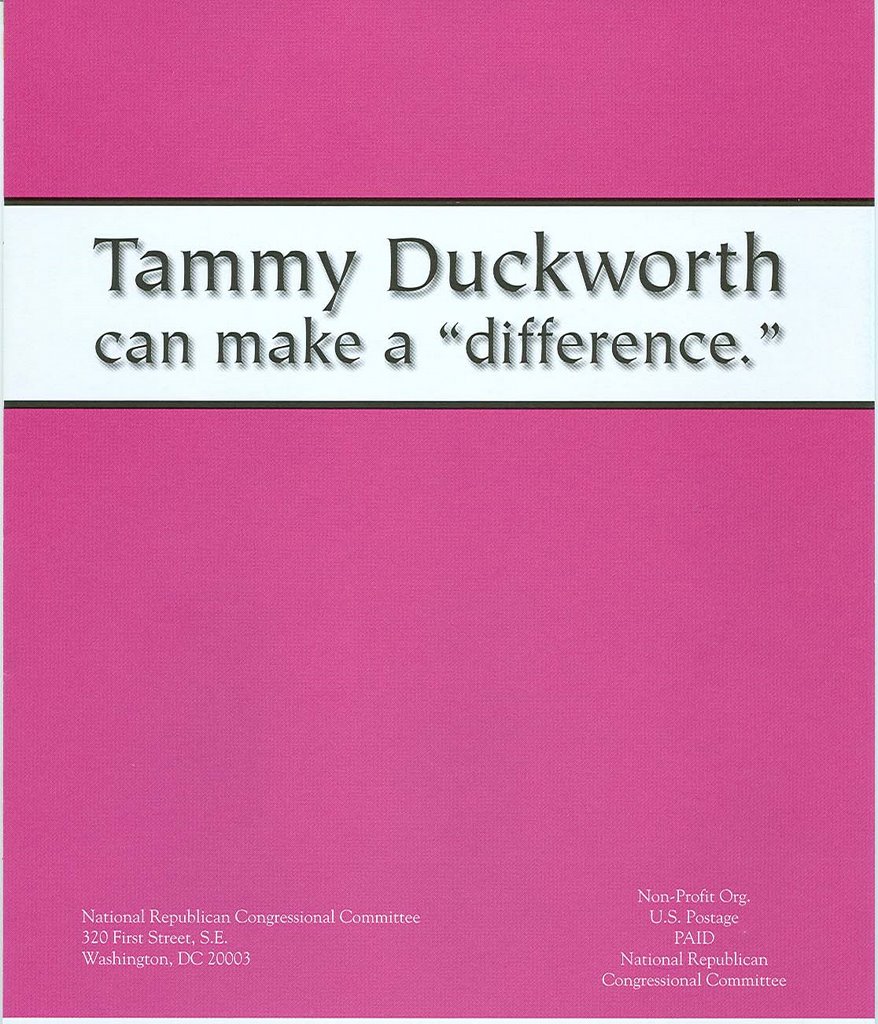
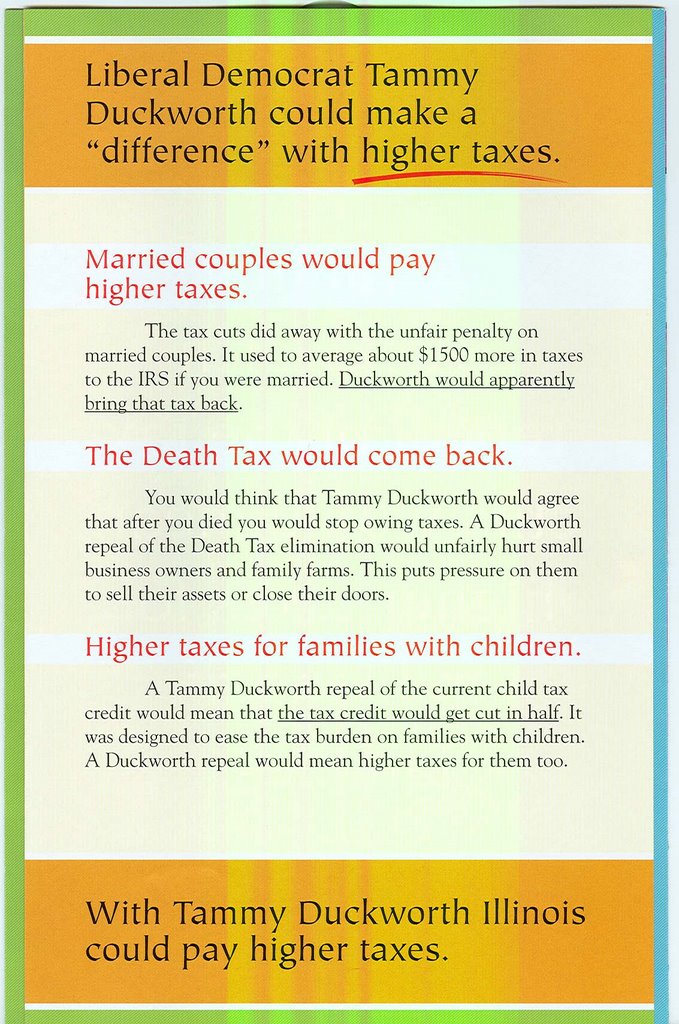
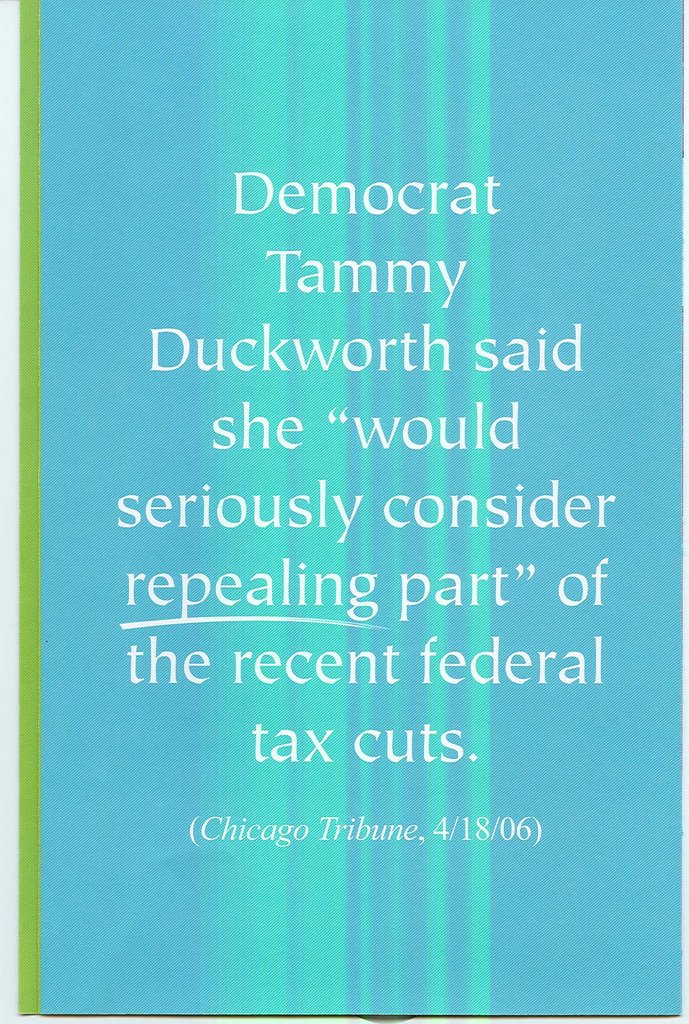
In several primaries, Obama's PAC has given to candidates that have been carefully culled and selected by the Democratic establishment on the basis of their marketability as palatable "moderates"--even when they are facing more progressive and equally viable challengers. Most conspicuously, Obama backed Joe Liberman over Ned Lamont, his Democratic primary opponent in Connecticut, endorsing him publicly in March and contributing $4,200 to his campaign. The Hopefund also gave $10,000 to Tammy Duckworth, a helicopter pilot in the National Guard who lost both legs in Iraq and who is running for the seat of retiring G.O.P. Congressman Henry Hyde in Chicago's western suburbs. Despite her support from the party establishment, an enormous fund-raising advantage, and sympathy she had due to her war record, Duckworth won the primary by just 1,100 votes over a vocal war opponent named Christine Cegelis. (When asked about her stand on the Iraq war by a reporter, Duckworth had replied, "There is a good and bad in everything.")
The calibration of Obama's own political rhetoric has been particularly evident in regard to the war in Iraq. At an antiwar rally in Chicago in October 2002, when Obama was still a state senator, he savaged the Bush Administration for its by then obvious plans to invade. "I don't oppose all wars," he said that day. "What I am opposed to is a dumb war. What I am opposed to is a rash war. What I am opposed to is the cynical attempt by Richard Perle and Paul Wolfowitz and other armchair, weekend warriors in this administration to shove their own idealogical agendas down our throats, irrespective of the costs in lives lost and in hardships borne."
Since taking office, Obama has become far more measured in his position. After Pennsylvania Congressman John Murtha called for withdrawal from Iraq last fall, Obama rejected such a move in a speech before the Chicago Council on Foreign Relations, saying the United States needed "to manage our exit in a responsible way--with the hope of leaving a stable foundation for the future." His stance won him praise from Washington Post columnist David Broder, the veritable weather vane of political convential wisdom. Murtha's was "not a carefully reasoned analysis of the strategic consequences of leaving Iraq," Broder wrote, whereas Obama was helping his party define "a sensible common ground" and had "pointed the administration and the country toward a realistic and modestly hopeful course on Iraq." Obama continues to reject any specific timetable for withdrawal from Iraq, even as public opposition to the war grows and as the military rationale for staying becomes less and less apparent.
For the past several decades, the two senators from Illinois have held a weekly meeting on Thursday mornings called the Constituent Coffee, where visitors from the Prairie State can meet and ask questions of their elected officials. Traditionally, the coffees have been low-key affairs, but since Obama took office they have been moved to a larger room--often on the top of the Hart Building, which looks out on the Capitol dome--that can accommodate the crowds they now invariably attract.
Obama and Richard Durbin, Illinois's senior senator and the Democrats' Senate minority whip, are a winning team. At one coffee I attended this summer, Obama noted in introducing Durbin that his colleague had recently been selected by Time magazine as one of the ten best members of the Senate. "Only ninety senators disagree," said Durbin in rejoinder, adding, "I haven't done the cover of Newsweek or won a Grammy. There's a pretty important junior senator from Illinois too." (Obama won a Best Spoken Word Grammy this year, for his reading of his autobiography.) At another coffee, Durbin mentioned to the crowd that Obama had thrown out the first pitch at a Chicago White Sox game last year; this, he noted, had sparked a long winning streak, at the end of which the team won its first World Series in eighty-eight years. Later, a student at the University of Illinois asked Obama if he might also throw out the first pitch for the perennial sad-sack Cubs, in order to impart similarly good luck. "My arm," Obama deadpanned, "is only so good."
By 8:30am on July 13, when that week's coffee was scheduled to begin, about 150 people had filled the seats and several dozen more were standing at the back. The top-floor space at Hart was not avaliable that day, so the coffee had been moved to a large hearing room in the basement of the neighboring Dirksen Building. A few stragglers huddled around a table near the entrance, picking from a platter of dough nuts and filling cups of coffee from a shiny metal urn. "The dough nuts are the main reason people come," Obama joked, opening the affair from a podium at the head of the room. In fact, it was clear that many in attendance--especially among the sizable contingent who weren't actually from Illinois, including many congressional interns and pages--had turned up just to see Obama.
Although Obama and Durbin did field some questions on foreign policy, especially on Israel's conflict with Hezbollah, the audience seemed more interested in domestic issues--health and education and basic pocketbook worries. What, one middle-aged woman asked pointedly, was Congress planning to do about the soaring price of gasoline?
Like the natural politician he is, Obama packaged his reply to appeal to the broadest spectrum of opinion. Energy, he said, was not just an economic issue but a national-security issue ("We now are dependent on the most volatile regions of the world for running our economy") and an environmental issue as well ("There are a lot of farmers in the room whose croplands could be impacted by global warming"). President Bush, said Obama, had finally acknowledged the need to break America's addiction to foreign oil, "but with the twelve-step program there are eleven other steps after you acknowledge your addiction." One step, he said, in bringing the issue home to Illinois interests, was to support biofuels such as ethanol, which are "a terrific way for us to start cutting down our use of imported oil."
Obama's support among traditional Democratic constituencies was apparent in the audience members, a number of whom worked for low-income housing, civil rights, and pro-choice groups. Grateful representatives of big-money interests were on hand as well, in the form of officials from the Illinois Soybean Association and the Illinois Corn Growers Association. "We appreciate the relationship and the help," said the latter, who was in town as part of a lobbying blitz called the Corn Congress.
And indeed Obama has delivered for his constituents--for social activists, but also for business groups whose demands are invariably more costly. Although this is not the place to review the full history of ethanol, it's beyond dispute that it survives only because members of Congress from farm states, whether liberal or conservative, have for decades managed to win billions of dollars in federal subsidies to underwrite its production. It is not, of course, family farmers who primarily benefit from the program but rather the agribusiness giants such as Illinois-based Aventine Renewable Energy and Archer Daniels Midland (for which ethanol accounts for just 5 percent of its sales but an estimated 23 percent of its profits.) Ethanol production, as Tad Patzek of UC Berkeley's Department of Civil and Environmental Engineering wrote in a report this year, is based on "the massive transfer of money from the collective pocket of the U.S. taxpayers to the transnational agricultural cartel."
Since arriving on Capitol Hill, Obama has been as assiduous as any member of Congress in promoting ethanol. He has introduced a number of measures that benefit the industry--such as the "Obama Amendment" that offered oil companies a 50 percent tax credit for building stations that offer E85 fuel-and voted for the corporate-welfare-laden 2005 energy bill, which offered billions in subsidies to ethanol producers as well as lavish incentives for developing cars that run on alternative fuels.
Meanwhile, Obama, Durbin, and three other farm-state senators opposed a proposal this year by the Bush administration to lower stiff tariffs on cheaper sugarcane-based ethanol from Brazil and other countries. To lower such tariffs, the senators suggested, would leave the nation dangerously dependent on foreign ethanol. "Our focus must be on building energy security through domestically produced renewable fuels," wrote the senators in a letter to Bush. That Obama would lend his name to such an argument-with its dubious implication that Brazilians ethanol is a national-security liability comparable to Saudi crude-indicates that he is at least as interested in protecting domestic producers of ethanol as he is in weaning America from imported petroleum.
I recall a remark made by Studs Terkel in 1980, about the liberal Republican John Anderson, who was running as an independent against Ronald Reagan and Jimmy Carter: "People are so tired of dealing with two-foot midgets, you give them someone two foot four and they start proclaiming him a giant." In the unstinting and unanimous adulation of Barack Obama today, one wonders if a similiar dynamic might be at work. If so, his is less a midgetry of character than one dictated by changing context. Gone are the days when, as in the 1970s, the U.S. Senate could comfortably house such men as Fred Harris (from Oklahoma, of all places), who called for the breakup of the oil, steel, and auto industries; as Wisconsins William Proxmire, who replaced Joe McCarthy in 1957 and survived into the 1980s, a crusader against big banks who neither spent nor raised campaign money; as South Dakota's George McGovern, who favored huge cuts in defense spending and a guaranteed income for all Americans; as Frank Church of Idaho, who led important investigations into CIA and FBI abuses.
Today, money has all but wrung such dissent from the Senate. Campaigns have grown increasingly costly; in 2004 it took an average of more than $7 million to run for a Senate seat. As Carl Wagner, a Democratic political strategist who first came to Washington in 1970, remarked to me, the Senate today is a fundamentally different institution than it was then. "Senators were creatures of their states and reflected the cultures of their states," he said. "Today they are creatures of the people who pay for their multimillion-dollar advertising campaigns. Representative democracy has largely been taken off the table. It's reminiscent of the 1880s and 1890s, when senators were chosen by state legislatures who were owned by the railroads and the banks." Accordingly, as corporate money has grown increasingly important to candidates, we have seen the rise of the smothering K Street culture and the revolving door that feeds it--not just lobbyists themselves but an entire interconnected world of campaign consultants, public-relations agencies, pollsters, and media strategists.
All of this has forged a political culture that is intrinsically hostile to reform. On condition of anonymity, one Washington lobbyist I spoke with was willing to point out the obvious: that big donors would not be helping out Obama if they didn't see him as a "player." The lobbyist added: "What's the dollar value of a starry-eyed idealist?"
Senator Obama's Office Responds to Misleading Harper's Magazine Story
The latest issue of Harper's Magazine contains a piece titled "BARACK OBAMA INC. The birth of a Washington machine." The story is unfortunately filled with a selective presentation of the facts, innuendo and a cynical assumption of bad faith in our leaders.While we do not doubt the integrity or the intelligence of the piece's author, Ken Silverstein, we feel that our side of the story was not fairly presented. Below are some misleading passages from the piece, and some facts we believe will help tell the full story.
Misleading Claim #1: Iraq
Harper's Magazine says Obama has changed his rhetoric on Iraq. Silverstein wrote, "The calibration of Obama's own political rhetoric has been particularly evident in regard to the war in Iraq...Since taking office, Obama has become far more measured in his position." [page 38]
Fact:
Obama has been consistent. He opposed the war from the start, but decided that once we were in Iraq, we needed to plan our withdrawal carefully. Frank Rich of the New York Times puts it succinctly: "On one true test for his party, Iraq, (Obama) was consistent from the start. On the long trail to a hotly competitive senatorial primary in Illinois, he repeatedly questioned the rationale for the war before it began. . . .. He judged Saddam to pose no immediate threat to America and argued for containment over a war . . . . He hasn't changed. In his new book, he gives a specific date (the end of this year) for beginning a phased withdrawal of U.S. troops. . . ' [New York Times 10/23/2006].
Misleading Claim #2: - Favors to the Nuclear Industry
Harper's Magazine implies that Obama voted to protect loan guarantees for energy technology on behalf of the nuclear industry. [page 37].
Fact:
Obama voted with 75 other Senators to promote a wide array of innovative energy technologies. The Sununu amendment in question would have eliminated loan guarantees to encourage emerging clean-energy technologies. These guarantees encouraged a wide array of renewable fuel. Besides nuclear energy, the guarantees can be used for solar and wind power, hybrid cars, hydrogen fuel cells, carbon sequestration, coal gasification and other technologies that reduce greenhouse gas emissions.
Obama voted against the Sununu amendment because he supports emerging technologies and believes many companies would not pursue advanced research without financial support. In the end, 76 senators opposed the amendment.
Misleading Claim #3: Support for Other Democrats
Harper's Magazine says Obama only gives funds to moderate, establishment Democrats, failing to note that Obama has donated to every Senate Democrat running for office in 2006. Harper's says "Obama's PAC has given to candidates that have been carefully culled and selected by the Democratic establishment on the basis of their marketability as palatable 'moderates'-even when they are facing more progressive and equally viable challengers." Harper's cites as examples Obama's political donations to Joe Lieberman over Ned Lamont, and Tammy Duckworth over Christine Cegelis. [page 37]
Fact:
Obama donated to every Democratic Senator running for reelection and then contributed to Ned Lamont after he won the primary. Harper's takes exception to Obama's decision to donate money to Senator Lieberman, but fails to note that Obama endorsed Ned Lamont and gave him $5,000 the day after Lamont won the nomination. Obama also donated money to every Senate Democrat up for reelection and to every Democratic challenger in a closely contested Senate race, including Sherrod Brown, Claire McCaskill, Sheldon Whitehouse, and Amy Klobuchar. Harper's also fails to note that in the most recent polls, Tammy Duckworth is defeating her GOP opponent, while Christine Cegelis only garnered 43 percent of the vote in 2004, a year when Alan Keyes was at the top of the Republican ticket in Illinois. John Kerry received 47 percent of the vote in that district.
Harper's Magazine misrepresents Tammy Duckworth's position on Iraq. Harper's also implies that Duckworth is a pro-war candidate, noting "When asked about her stand on the Iraq war by a reporter, Duckworth had replied, 'There is good and bad in everything.'" [page 37-38] Duckworth, an Iraq war veteran, says on her website "invading Iraq was a mistake."
Misleading Claim #4: Ethanol
Harper's Magazine implies that Obama has supported ethanol production because the country's largest ethanol producer, ADM is based in Illinois. Harper's also argues that from a conservation standpoint it is potentially better to drive a standard gasoline car than a flex-fuel vehicle. [page 32].
Fact:
Senator Obama supports ethanol production because it is a clean, efficient, and domestically produced alternative to oil from the Middle East. According to the Environmental Protection Agency, E85 fuel produces fewer total toxins and lower levels of ozone-forming volatile organic compounds compared to gasoline. The U.S. Department of Agriculture has determined that ethanol production is efficient, creating 1.67 times the energy it takes to produce it. Argonne National Laboratory reports that by switching to ethanol and biomass fuels in our passenger cars and light-duty trucks, drivers can potentially reduce the use of petroleum by at least 68 percent. Blending ethanol with gasoline just at a 10 percent level will translate to savings to consumers of $3.3 billion a year according to independent researchers at LECG (based on 2002 prices).
[Sources: 1, 2, 3, 4]
Senator Obama wants to enable more entrepreneurs and small businesses to develop ethanol. Senator Obama supports a renewable fuels standard that would encourage ethanol production by expanding demand for renewable fuels and further diversifying the ethanol industry, thereby ensuring much greater competition in the U.S. liquid fuels market in the future.
Misleading Claim #5: Democratic Convention Speech
Harper's Magazine suggests that Senator Obama was chosen to speak at the Democratic National Convention only after he had received the blessing of Washington lobbyists and fundraisers. "If the speech was his debut to the wider American public, he had already undergone an equally successful but much quieter audition with Democratic Party leaders and fund-raisers, without whose support he would surely never have had been chosen for such a prominent role at the convention." [page 36]
Fact:
The decision to choose Senator Obama was made by Senator John Kerry's campaign, not by lobbyists. After Obama's selection as the keynote speaker at the 2004 Democratic National Convention, Senator Kerry's aides were very clear about their rationale. According to the Chicago Tribune: "For the Kerry campaign, the choice of Obama has great meaning as officials try to dispel criticism that they have done a poor job of reaching out to African-American voters. Kerry began to focus on Obama, the Democratic candidate for Senate in Illinois, for a role at the convention after meeting him for the first time and listening to him speak at a gala fundraiser in Chicago in April. The next day, Kerry and Obama toured the Greater West Town Community Development Project, visited a bakery, and held a town hall meeting together. An aide to Kerry said the Massachusetts senator was struck by Obama's 'passion, eloquence and charisma.' [Chicago Tribune, July 15, 2004]
Misleading Claim #6: Private Jets
Harper's Magazine wrongly says that Obama stopped taking privately subsidized air travel because of bad press. "[A]fter some atypically bad press for accepting flight, Obama imposed a ban at his office on privately subsidized travel." [page 40, footnote]
Fact:
Obama voluntarily chose to reimburse the full fare for private flights - not just the first-class fare as Senate rules require - because he felt it was right. Obama voluntarily chose to reimburse full fare on private flights despite less stringent Senate rules because he thought it was the right thing to do. Obama's decision actually garnered Obama favorable press coverage. "Senator Barack Obama flew at least nine times on corporate jets last year...each time, he reimbursed the plane's owners at first-class rates, as Senate rules require. But Mr. Obama, freshman Democrat from Illinois, felt queasy about this perk of Senate life, so he said he gave it up. 'This is an example where appearances matter,' he said." [New York Times, March 8, 2006]
Misleading Claim #7: Organized Labor
Harper's Magazine suggests that Obama's hiring of a former staffer for Treasury Secretary Robert Rubin makes him susceptible to policies that hurt organized labor. Harper's writes, "[Obama] hired Karen Kornbluh, a senior aide to Robert Rubin when the latter, as head of the Treasury Department under Bill Clinton, was a chief advocate for NAFTA and other free-trade policies that decimated the nation's manufacturing sector". [page 33]
Fact:
Obama has a strong pro-labor voting record. Obama voted against the Central American Free Trade Agreement and has said that NAFTA should be renegotiated. Obama has cosponsored many important bills to help workers, including: an increase in the minimum wage, and the Employee Free Choice Act. He also championed efforts in the Senate to help air traffic controllers engaged in a labor dispute with the Federal Aviation Administration
Misleading Claim #8: Calling to Action
Harper's Magazine criticizes Obama for calling on students only to strive for energy independence during a speech in July. "Obama's speech contained just a single call for political action. This was when he had introduced Mark Pike, a law student who then came bounding across the state in a green one-piece mechanic's outfit. As part of a campaign called 'Kick the Oil Habit,' Pike was to depart directly from the conference and drive from Washington to Los Angeles in a 'flex-fuel' vehicle. 'Give it up for Mark!' Obama had urged the crowd, noting that Pike would be refueling only at gas stations that offer E85-which Obama touts as 'a clean, renewable, and domestically produced alternative fuel.'" [page 32]
Fact:
Obama was specifically asked to touch on only two themes in his speech. The group that organized the event - the Center for American Progress - specifically asked Obama to touch on two themes in his speech, 1) what inspired him to go into politics, and 2) briefly the importance of energy independence.
A Bit More on Barack
Senator's office criticizes Harper's storyreprinted from Harper's Magazine
By: Ken Silverstein
The November issue of Harper's Magazine is just hitting newsstands everywhere, and I've received quite a few comments about my story on Senator Barack Obama. That tally includes several lengthy conversations with a staffer in Obama's office, who graciously but firmly rejected some of the article's contentions. Late Monday, Obama's office issued a press release that challenged parts of the story.
The staffer—and some readers—took issue with my statement that Obama had “established a political machine funded and run by a standard Beltway group of lobbyists, P.R. consultants, and hangers-on.” But if you examine Obama's campaign finance records carefully, it's hard to reach any other conclusion. Here are some additional details that were not included in the article.
Since announcing his candidacy for the Illinois Senate seat, Obama has raised the astonishing sum of nearly $21 million and has built close relationships with a number of traditional fat-cat donors. For example, one of Obama's leading career patrons is Skadden, Arps ($53,271, according to the most recent disclosure filings), a leading corporate law firm and one of the biggest donors to the Democratic Party.
Several of the firm’s lawyers donated money to Obama and also helped raise money for him as well. That includes Christina Tchen, a corporate litigator at Skadden who has represented major financial firms in consumer class-action suits. (Tchen is on the board of trustees of the University of Chicago Hospitals, where Obama’s wife, Michelle, is vice president for community and external affairs.)
In November of last year, three other Skadden attorneys helped organize a fundraiser for Obama's Leadership PAC, the vehicle he uses to support other Democratic candidates, and to boost his own political profile and gain support within the party. They were: Vivenne LaBorde, a former aide to Congressman Chaka Fattah and a senior attorney in the firm’s Mergers & Acquisitions department; Toni Cook Bush, a former senior counsel to the communications subcommittee of the Senate Commerce Committee and now a representative for cable, satellite and telephone companies; and Vaughn Williams, whose practice “emphasizes securities and corporate litigation, including class action litigation,” according to the firm’s website.
Others who have helped raise funds for Obama's Leadership PAC include John Gorman of Texas-based Tejas Securities, a major funder of Senate Democrats (and of the Bush presidential campaigns) and Winston & Strawn, the Chicago-based law and lobbying firm. Individual contributors to Obama include some of the best-connected lobbyists in town, including Jeffrey Peck (whose clients include MasterCard, the Business Roundtable, and the U.S. Chamber of Commerce) and Rich Tarplin (Chevron, the American Petroleum Institute, and the National Association of Manufacturers).
In the magazine article, I asserted that Obama is not a mouthpiece for his donors; neither does his voting record mirrors the wishes of his contributor list. But, as I suggested, it's naïve to think that he's completely unaware of who's footing the bills. Exelon, a leading nuclear-plant operator based in Illinois, is a big donor to Obama, and its executive and employees have given him more than $70,000 since 2004. The Obama staffer pointed out that the senator pushed for legislation that would require nuclear companies to “inform state and local officials if there is an accidental or unintentional leak of a radioactive substance,” according to an office press release. Obama took a stand on that issue following reports that a plant operated by Exelon had leaked tritium several times over the past decade.
But Exelon is probably not entirely unhappy with Obama. At a 2005 hearing at the Senate Committee on Environment & Public Works, of which Obama is a member, the senator—echoing the nuclear industry's current campaign to promotes nuclear energy as “green”—said that since Congress was debating “policies to address air quality and the deleterious effects of carbon emissions on the global ecosystem, it is reasonable—and realistic—for nuclear power to remain on the table for consideration.” He was immediately lauded by the industry publication Nuclear Notes, which said, “Back during his campaign for the U.S. Senate in 2004, [Obama] said that he rejected both liberal and conservative labels in favor of ‘common sense solutions.’ And when it comes to nuclear energy, it seems like the Senator is keeping an open mind.”
To anyone who thinks Obama is blissfully oblivious to the fundraising imperative, consider the following: in one of his earliest votes as a senator, Obama helped pass a class-action “reform” bill that was a long-standing and cherished goal of business groups. (The bill was the focus of a significant lobbying effort by financial firms, who constitute Obama's second-biggest single bloc of donors.)
The bill was also heavily championed by high-tech firms. Shortly after the vote, dozens of big-donor executives affiliated with a PAC called TechNet came to Washington for an annual lobbying trip. The agenda was top-heavy with White House officials and congressional Republicans, but Obama was picked to address the PAC’s policy lunch, and a draft of the speech was posted on his website. “None of us expect or want the government to lead the next technological revolution,” Obama told the assembled contributors, “but I believe that we can provide the spark that fuels America’s innovation and competitiveness in the global economy. We can do better than burdening businesses with cases of class-action abuse, and that’s why I cast a tough vote in favor of reform the other week.”
Obama has said that's he's considering a presidential bid. He has a lot of attractive qualities and a pretty solid record, but that kind of ambition requires deep pockets and good connections. The magazine article was intended to explore the conflict between those two sets of facts and to examine the obstacles that it may present.
As to Obama's press release, I had my say in the magazine and I think the senator's office is entitled to its reply. There's much I disagree with in the press release, however, particularly in the way that my own article was summarized.
To take one — and only one — example, the press release says that I suggested that Obama's “hiring of a former staffer for Treasury Secretary Robert Rubin makes him susceptible to policies that hurt organized labor.” I said no such thing — and I agree that Obama has a generally strong record in support of organized labor. I mentioned the hiring of Karen Kornbluh only to note that Obama's political team, from advisers to funders, is mainstream and conventional and his choices don't indicate a strong desire to take on entrenched interests.
I could go on for quite awhile here, but you can judge for yourself by reading the article in the magazine and the press release issued by Obama's office.