Thursday, August 24, 2006

"Pork Barrel" Peter Focuses on Tax Cuts

Roskam focuses on tax cuts

BY PAT CORCORAN | STAFF WRITER
pcorcoran@pioneerlocal.com

GOP congressional candidate and state Sen. Peter Roskam wants to steer the election dialogue toward a conservative stand-by -- cutting taxes.

During an Aug. 2 campaign stop at the Bensenville offices of Central States Trucking, Roskam said that the starkest contrast between himself and Democratic nominee Tammy Duckworth is his pro-growth approach to tax policy.

The state lawmaker has pledged to eliminate the inheritance tax, also known as the "death tax," and said Duckworth needs to clarify to voters her position on taxes.

"I have a record now of almost 13 years in the General Assembly as a tax fighter and I have said unambiguously that I am in favor of making the tax cuts permanent," he said. "My opponent has been very ambiguous on that issue."

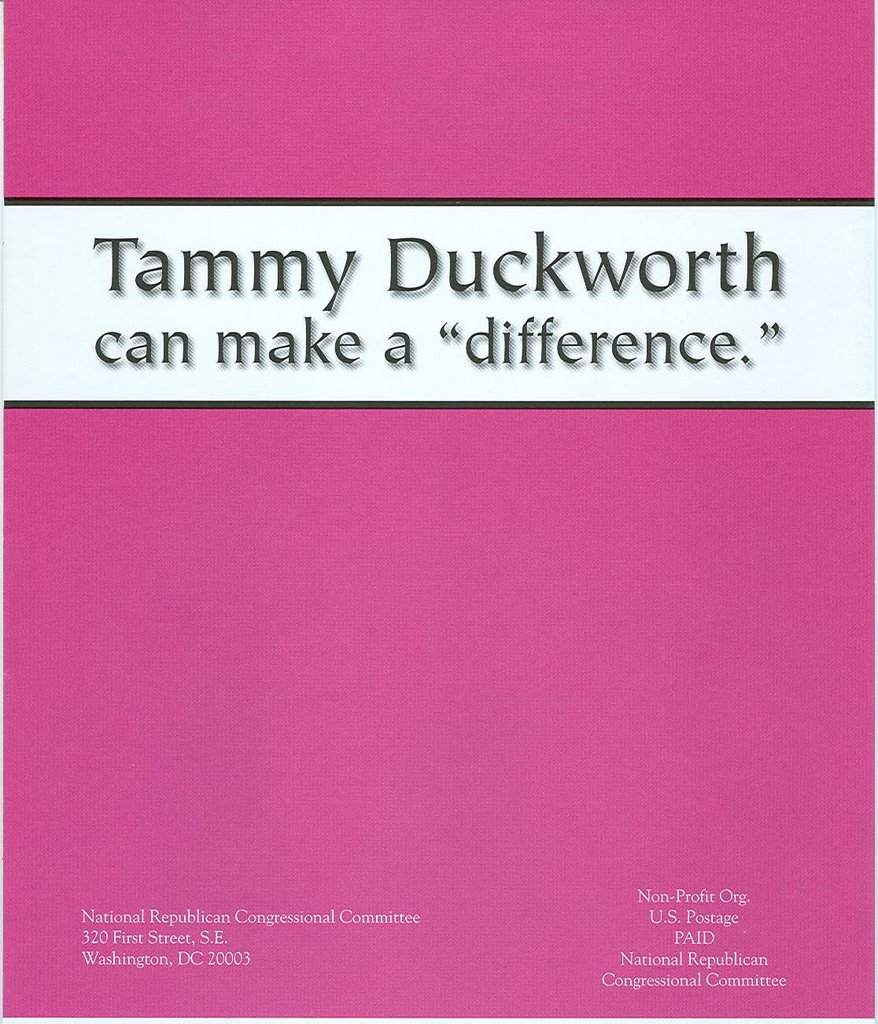
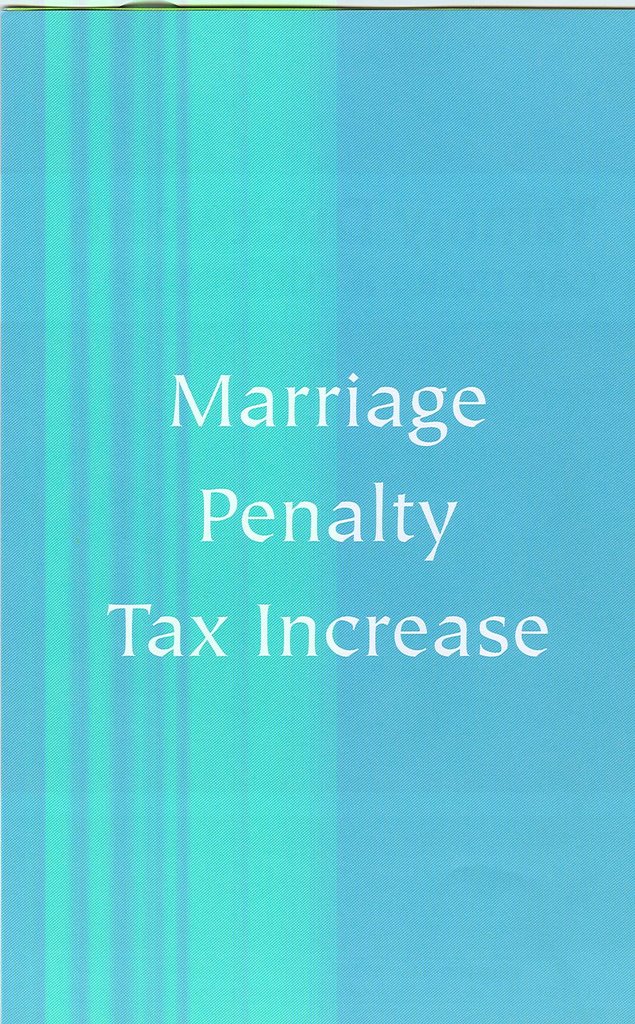
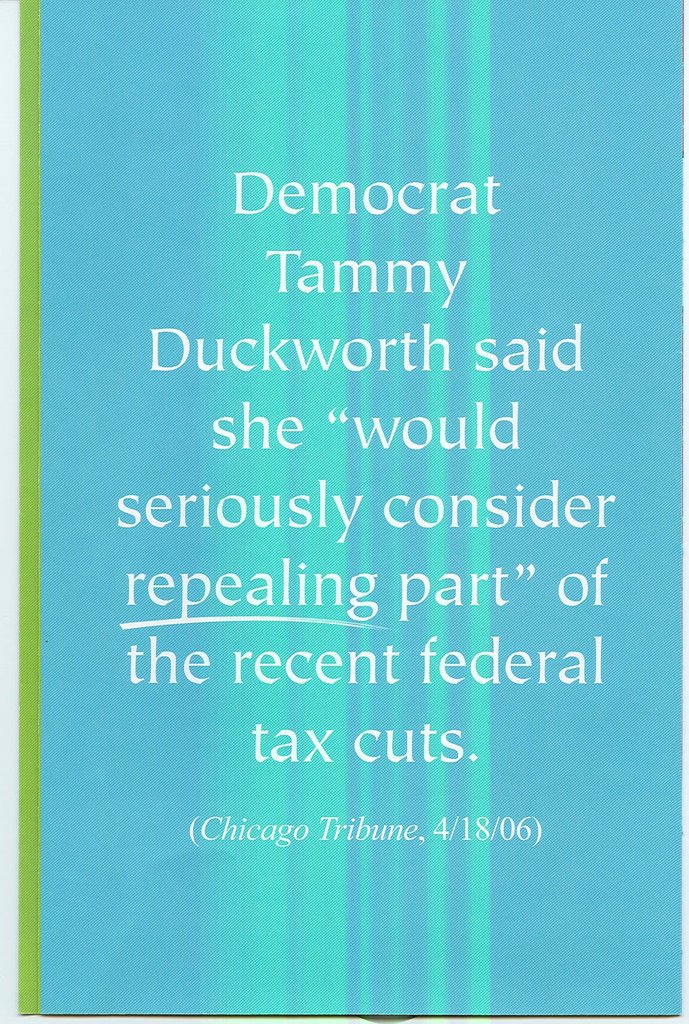
The stop in Bensenville coincided with the release of a Roskam campaign mail piece that claims Duckworth would make Illinois families pay higher taxes. The flier targets Duckworth's middling position on the Bush tax cuts, which she supports, but only in part.

Both candidates agree on the portion of the Bush plan that provide families with per-child and child care tax credits. They also agree that income tax rate cuts and the repeal of the marriage penalty should be made permanent.

Duckworth has repeatedly called for an end to tax subsidies for the oil industry and tax relief for middle-class -- but not wealthy -- families. For example, she disagrees with Roskam's position on the inheritance tax. Currently, the tax hits only those individuals with estates valued at more than $2 million.

Duckworth cites statistics that say a full repeal of the it would add more than $300 billion to the federal deficit and benefit only 8,000 U.S. families.

The exemption level is scheduled to rise to $3.5 million in 2009. At that level, only 3 of every 1,000 people who die will have an estate large enough to owe any tax, according to the Center on Budget and Policy Priorities.

"There's different ways to be fiscally responsible while helping middle-class families and reigning in the budget. The Bush administration has stood by while costs for middle-class families such as tuition, health care and costs at the fuel pump have gone up," Christine Glunz, Duckworth spokeswoman, said.

By one U.S. Treasury Department estimate, the nation is $3.5 trillion in debt and rapidly heading toward $4 trillion thanks in part to paying for the wars in Afghanistan and Iraq.

Glunz called Roskam's talk of fiscal restraint out of place considering a Republican-controlled Congress oversaw years of excessive spending.

"I think it's obvious to most people that Congress has gone from having a hefty surplus to hundreds of billions of dollars in debt ... putting our economic security at risk," she said.

Roskam acknowledged the need for spending cuts and pointed to his record in the Democrat-controlled General Assembly as evidence that he can push for them in Congress.

"What we've seen in Illinois is an economy that is simply lagging ... compared to our border states," he said. "Why is that? Because of a lack of discipline, a lack of discipline on spending on programs like All Kids. I've been a critic of (Gov. Rod Blagojevich) for three years on the Senate floor in my role as the whip."

All Kids is Blagojevich's program to provide medical insurance to children whose parents cannot afford it.

Roskam, who was joined by U.S. Rep. Phil English, R-Pa., a member of the House Ways and Means Committee, said long-term, the deficit issue will be addressed in part by the Bush tax cuts which will rev up the economy leading to increased tax revenues and improved employment and wage levels.

"Think about a company when taxes are cut. What will they typically do? They reinvest in the company," he said. "The trend line has shown us over and over again that when you cut taxes, things are dynamic and exciting and vibrant."

Copyright© 2006, Digital Chicago Inc.

http://www.pioneerlocal.com/cgi-bin/ppo-story/localnews/current/mp/08-24-06-1010755.html.printable?paper2=mp

Wednesday, August 23, 2006

The Economist:: Rahm offers some “Big Ideas for America”

Rahmbo's Plan
Aug 17th 2006
From The Economist print edition


The House Democrats' chief enforcer offers some “Big Ideas for America”

RAHM EMANUEL, a congressman from Illinois, is often compared to Newt Gingrich. The head of the Democratic Congressional Campaign Committee is clever, energetic and utterly determined to win back the House of Representatives in November. He is also, like the man who led the Republicans to just such a triumph in 1994, somewhat abrasive. He once sent a rotting fish to a pollster who irked him. When he was only 32, his aggressive fundraising helped Bill Clinton win the presidency. At a dinner afterwards, while others celebrated, he snatched up a steak knife and started plunging it into the table, naming his political enemies and yowling “Dead!” after each stab.

Some say Mr Emanuel learned to act tough to pre-empt the jeers he might otherwise have attracted as a schoolboy ballet dancer in Chicago. (He was good—his mother was apparently upset when he turned down a scholarship to the Joffrey Ballet school.) Be that as it may, his style seems to work. “Rahmbo”, as he is known, is skilled not only at squeezing money out of donors (if the pledge is too small, he lets them know), but also at making sure that the candidates who get it campaign effectively. He makes them sign agreements specifying how many appearances and fund-raising phone calls they will make. He approaches his job “with the sensibility of a Mob bookie”, gushed a profile in Rolling Stone last year.

Next week Mr Emanuel will publish his answer to Mr Gingrich's “Contract with America”, the small-government manifesto that helped Republicans capture the House in 1994. It is called “The Plan: Big Ideas for America”, and is co-written with Bruce Reed, an old chum from the Clinton White House. It has signs of being written in a hurry. Was America in the 1950s and 1960s “a land of opportunity and certainty”, as he tells us on page 31? Or has it “always been a land of opportunity, not certainty”, as he says 11 pages later? The obligatory Bush-bashing is stale and waffly: “Bush inherited the longest economic boom in history and gave the middle class the highest anxiety in memory.” But the Plan itself is solid and mostly sensible.

Probably the main reason wages have not risen much in recent years is that health-insurance premiums, which many American employers shoulder, have soared. The Plan lists ways to curb them. Doctors, rather than being paid for every test and injection they provide—an arrangement that inevitably leads to over-doctoring—should be paid by results. Patients should be given better incentives to stay healthy: insurers, for example, should push them to take free physical exams to spot ailments early. Better use of information technology could supposedly save $162 billion a year. If the system is made more efficient, Mr Emanuel thinks coverage can be extended to all American children. But he concedes that a nation as individualistic as America will probably never accept a European-style national health service—and he should know, having worked on Hillary Clinton's doomed health project in the 1990s. He argues, however, that maybe, some day, every American might receive a voucher for basic health services from the insurer of his or her choice.

Mindful of the teachers' unions, he avoids the V-word when discussing education. But he has some sensible ideas. Subsidies for those who cannot afford to go to college are currently too complex; he would replace the five main schemes with a single $3,000-a-year tax credit. Teachers should be paid for performance, not just credentials. And schoolchildren should take shorter holidays. (The Democratic Leadership Council, a moderate Clintonian body, made the same proposal last month.)

Americans are not saving enough for retirement. Well, some are. Mr Emanuel, after six years as a White House aide, earned $16m in two and a half years as an investment banker. For those who lack his quick wits and fat Rolodex, however, he proposes other ways to build up wealth. Employees should automatically be enrolled in 401(K) pension schemes unless they object. The middle class should be exempt from capital-gains tax. And families with an income of less than $100,000 a year should surrender no more than 10% of it to the taxman. As a congressman, Mr Emanuel has proved himself something of a tax wonk, co-sponsoring a plan to do to the tax code's complexities what he once fantasised about doing to his political enemies.

Perhaps the most arresting part of the Plan concerns national security, the Democrats' perennial weak spot. Again echoing Senator Clinton, he wants 100,000 more soldiers for America's overstretched army. He also wants an elite agency to fight domestic terrorism, like Britain's MI5. Of George Bush's Department of Homeland Security, he scoffs: “[It] has 180,000 employees. The London bombings in July 2005 were the work of four men with backpacks. Whose organisation chart would you rather have?” Most radically, he wants all Americans aged 18-25 to undergo three months of compulsory disaster-training.


Wouldn't it be more efficient to hire more professionals—paramedics, firemen and so forth? Not in Mr Emanuel's view. He does not want merely to prepare for future disasters; he thinks his “universal citizen service” will bring youngsters of all backgrounds together and teach them what it means to be American. “The French abandoned the idea [of national service] a decade ago, and now watch their young people riot in the streets,” he says. This is a feeble explanation for the French riots. And Mr Emanuel's scheme will remind many Americans that the Democratic Party likes social engineering more than they do.

As a whole, the Plan will help rebut the charge that the Democrats have no ideas. And if they win in November, they can always ditch the more radical parts. A Plan is less binding than a Contract, and Mr Emanuel is not the Democrats' leader in the House. At least, not yet.


Copyright © 2006 The Economist Newspaper and The Economist Group.

http://www.economist.com/displaystory.cfm?story_id=7796602

Daily Herald: Roskam Defends Federal Pork Support

Roskam defends federal pork support

By Eric Krol
Daily Herald Political Writer
Posted Tuesday, August 22, 2006

Republican congressional hopeful Peter Roskam, who’s always billed himself as a fiscal conservative, tried to walk a political tightrope Monday by embracing an oft-criticized budget tactic for securing federal funding for local projects.

The 6th Congressional District GOP nominee said he’d support continuing the so-called practice of “earmarks” if elected to Congress to make sure projects like fixing the dangerous railroad crossing at Irving Park and Wood Dale roads continue to get funded.

“I don’t think we should leave it to a bureaucrat in Washington, D.C., who’s in a gray building and goes to sleep in the suburbs of Virginia every night and has never been to Wood Dale making fundamental decisions about the life and health and safety of Wood Dale,” said Roskam at Wood Dale city hall.

Democratic opponent Tammy Duckworth has vowed to end earmarks, calling the practice wasteful and corrupt in an era of record budget deficits. Duckworth’s campaign, which puts out a news release every week highlighting pork projects, criticized Roskam.

“He’ll continue more of the same in Congress,” Duckworth spokeswoman Christine Glunz said. “He’s trying to defend himself on an issue he’s clearly weak on.”

When asked how Duckworth would bring home the proverbial bacon for the 6th District, Glunz said projects like the railroad crossing would get funded on merit.

Roskam said he would back a change to make earmarks more transparent, requiring the sponsoring congressman’s name to be listed.

The Wood Dale intersection has had 128 crashes in three years, making it the most accident-prone railroad crossing in Illinois. Retiring Congressman Henry Hyde has secured $11 million to create an underpass, but the project costs $65 million, officials said.

Physician Lanny Wilson, who lost his 14-year-old daughter Lauren in a 1994 accident at a Hinsdale crossing when his son tried to outrun a train by going around the crossing gates, said it’s crucial the project be completed.

In other 6th District race news, the National Republican Campaign Committee recently reserved $2.3 million worth of TV ad time for the final weeks before the Nov. 7 election. The move matches an earlier Democratic Congressional Campaign Committee reservation of $2.3 million of campaign time. If history holds, both parties will spend that money to air negative attack ads about the other party’s candidate.

http://www.dailyherald.com/search/searchstory.asp?id=218930

And the Amazing Technicolor Mailer


Saturday, August 19, 2006

More DeLay Ties for Roskam

Congressional race starts getting nasty
http://www.dailyherald.com/news/illinoisstory.asp?id=217841


Posted Friday, August 18, 2006

The first bit of political nastiness in the 6th Congressional District race surfaced Thursday about the ethical pasts of key campaign staff for both Republican Peter Roskam and Democrat Tammy Duckworth.

The Duckworth campaign initially criticized Roskam for allowing the national GOP to send in veteran operative Jason Roe, pointing to his past work for indicted ex-House Majority Leader Tom DeLay of Texas and involvement in an ethics investigation about a prescription drug vote.

“I think it’s clear that the alarm bells have gone off about Peter Roskam’s campaign,” Duckworth spokeswoman Christine Glunz said. “Sending in someone who has ties to Tom DeLay as well as someone who is doing dirty work, strong-arming and twisting arms on the Medicare bill.”

But the National Republican Campaign Committee was able to boomerang the ethics rap on Roe back at Duckworth, pointing out that her campaign manager, Jon Carson, was granted immunity as part of a 2001 probe into political corruption involving a prominent Wisconsin Democrat.

Jonathan Collegio, a spokesman for the National Republican Campaign Committee, called the Duckworth campaign’s criticisms “stunningly hypocritical.”

“(Duckworth) has resorted to Chicago Democrat machine-style mudslinging and dirty tricks,” Collegio said.

The charges and counter-charges amounted to “your campaign worker has more ethical baggage than our campaign worker.”

Roe worked three weeks on DeLay’s 2004 re-election campaign helping with get-out-the-vote efforts. DeLay since has lost his majority leader position amid scandal, but Roe is not involved in that.

Also, a 2004 House ethics report shows Nick Smith, then a Michigan congressman, testified that Roe told him his son who was running to succeed him could receive “substantial support” if the elder Smith voted for the federal prescription drug plan. Roe pointed out the report clears him of any wrongdoing and said he only was responding to Smith’s question about the ramifications of a vote.

Carson briefly worked as the No. 2 staff member for then-Wisconsin Senate Democratic leader Chuck Chvala, who was eventually sentenced to nine months for political corruption. Carson, who was not accused of any wrongdoing, was granted immunity from prosecution and paid his own legal bills.

Wednesday, May 17, 2006

From: Think Progress

Big Oil Launches Attack On Al Gore

By Faiz on Radical Right-Wing Agenda

Today, the Competitive Enterprise Institute (CEI) will unveil two 60-second TV ads focusing on what it calls “global warming alarmism and the call by some environmental groups and politicians to reduce fossil fuel and carbon dioxide emissions.” The ad, which will be aired in more than a dozen cities across the country, is being released just a week before the May 24th opening (in LA and NYC) of Al Gore’s new movie on global warming, An Inconvenient Truth.

Who is CEI? The Washington Post explains:

The Competitive Enterprise Institute, which widely publicizes its belief that the earth is not warming cataclysmically because of the burning of coal and oil, says Exxon Mobil Corp. is a “major donor” largely as a result of its effort to push that position.

CEI also gets funding from other oil companies through the American Petroleum Institute.

Exxon documents reveal the company gave $270,000 to CEI in 2004 alone. $180,000 of that was earmarked for “global climate change and global climate change outreach.” Exxon has contributed over $1.6 million to CEI since 1998.

CEI’s general counsel Sam Kazman said, “I think what attracted [Exxon] to us was our position on global warming.” CEI’s position? The Institute believes the dangers of global warming are akin “to that of ‘an alien invasion.’

Exxon’s spokesperson Tom Cirigliano has explained why the company is so dedicated to funding CEI’s pushback on global warming:

We want to support organizations that are trying to broaden the debate. … There is this whole issue that no one should question the science of global climate change that is ludicrous. That’s the kind of dark-ages thinking that gets you in a lot of trouble.

The science is not questioned because the science behind global warming is indisputable. Science Magazine analyzed 928 peer-reviewed scientific papers on global warming published between 1993 and 2003. Not a single one challenged the scientific consensus that the earth’s temperature is rising due to human activity. The U.S. Climate Change Science Program concluded that humans are driving the warming trend through greenhouse gas emissions. And the EPA has said that the recent warming trend “is real and has been particularly strong within the past 20 years…due mostly to human activities.”

For the oil industry, Al Gore’s film exposing the truth is perceived as a threat, and they have no shortage of funds to try to distort it.

Tuesday, April 11, 2006

Chicago Tribune: Apartment shortages squeeze young, poor; As units dwindle, rents march higher

From your March 9, 2006 Chicago Tribune:
Apartment shortages squeeze young, poor;
As units dwindle, rents march higher

LaDonna Dennis and her 9-year-old son want to live in a safe neighborhood on the South Side. But to do that, she may have to spend more than half of her $1,400-a-month income on rent.

The 48-year-old single mother, like many other renters in Chicago and across the country, faces dramatically higher rents as the housing boom has swept away old buildings and turned others into expensive condominiums.

Cook County is losing about 3,400 rental units each year, part of 200,000 units disappearing annually across the country. The shortage was outlined Wednesday in the first comprehensive study of the U.S. rental housing market by Harvard University's Joint Center for Housing Studies. It was sponsored by the John D. and Catherine T. MacArthur Foundation in Chicago.

Nationally, about 2 million apartments--more than 6 percent of the rental stock--were lost between 1993 and 2003, the last full year for which numbers are available.

The loss of affordable rentals is putting pressure on groups of people who can least afford to cope with the increased costs: the young and the poor.

Some 34 million households, about one-third of the nation's total, live in rental units, a fact overshadowed in recent years by the housing boom.

"We are taking one step forward and two steps back as gentrification in some neighborhoods and continued deterioration in others leads to the removal of vitally needed lower-cost rental housing," said Joint Center director Nicolas Retsinas.

In the downtown Chicago market alone, 2005 was the biggest conversion year in 25 years, according to Appraisal Research Counselors of Chicago, which only tracks buildings of 25 units or more. More than 3,800 units were converted to condos last year.

John Bartlett, executive director of Chicago's Metropolitan Tenants Organization, said the condo conversions are a "serious problem" in the city as once-affordable apartments are "turned into places that people cannot afford."

Two years ago, "there used to be lots of apartments you could find for $700," Bartlett said, "and now that's non-existent. Some of the places along the lake, they're going to be $1,200 to $1,400 for a one-bedroom apartment."

Bartlett estimated that the average price for a one-bedroom in Chicago now is about $1,100, with the average two-bedroom nearly $1,800. That's "completely out of reach. For a low-income renter, there is going to have to be some kind of subsidy" to afford it, he said.

The problem varies by neighborhood, but Bartlett's group increasingly is getting calls from people who can't afford the rent in places such as Rogers Park and the South Side's 4th and 5th Wards. "Even in the 28th Ward [West Side]--we are getting way more calls than we ever did," in an area that used to have a high density of rentals.

"Those kinds of low rentals are needed," Bartlett said. A person would need to earn about $30,000 a year to afford the current average rent, he said.

"People making minimum wage" can't do it, he said, adding that his group is seeing more doubling up of family members in one apartment, and more friends moving in together. "People can't afford to live on their own."

Garth Taylor, president of the Metro Chicago Information Center, a policy research center, said about 308,000 of the local households renting are considered rent-burdened, which means they spend 30 percent or more of household income on rent. Nearly 62,000 households are severely rent-burdened, which means more than 50 percent of income goes to rent.

Consider Dennis. She pays $500 a month, or roughly a third of her monthly income, for a two-bedroom unit in a six-flat building in the South Shore neighborhood.

Since January, the hospital worker has narrowed her search to the South Side neighborhoods of Bronzeville, North Kenwood and Woodlawn, where public housing complexes have been redeveloped into mixed-income developments. She's on a long waiting list for a new Bronzeville unit near her church.

"They've torn down a lot of Chicago public housing and they are rebuilding for mixed-income. The rents are running like $850 for two-bedrooms and $1,000 for three-bedrooms," said Dennis. "If I could find a two-bedroom for $850, I'd be happy."

Cook County has an estimated 748,000 rental units, about 39 percent of the county's housing, according to Chicago Metropolis 2020, a business-sponsored think tank that studies regional issues. This is down from 831,400 in 2000.

And by 2009, 32,000 rental units with government subsidies in Cook County are at risk as government supports expire.

Eighty percent of all households 25 years or under are renters and two-thirds of households ages 25 to 29 live in apartments, the Harvard study reported.

Median listed rent for new-construction buildings rose from $734 in 1994 to $974 in 2004. During the same period, monthly renter income rose from $2,272 to $2,348.

Illinois and the Chicago area may be especially vulnerable to those pressures, noted Frank Beal, executive director of Chicago Metropolis 2020.

The Chicago area is consistently falling behind the rest of the country in building new rentals, Beal said. The Cook County tax codes are unfavorable for large rental buildings and Illinois laws are favorable to conversions, he said. In addition, the region has 272 municipalities, which can keep out rental buildings if officials deem it in the interest of the town.

Monday, February 27, 2006

Tribune 2004 Endorsements

The Tribune's endorsements
Chicago Tribune
November 2, 2004


These are the Chicago Tribune editorial board's endorsements in Tuesday's elections.

Endorsements are made only in contested races.

NATIONAL OFFICES

U.S. PRESIDENT

George W. Bush (R)

U.S. SENATE

Barack Obama (D)

U.S. HOUSE

1st District

Bobby Rush (D)

2nd District

Jesse Jackson Jr. (D)

3rd District

Daniel Lipinski (D)

4th District

Luis Gutierrez (D)

5th District

Rahm Emanuel (D)

6th District

Henry Hyde (R)


7th District

Danny Davis (D

8th District

Melissa Bean (D)

9th District

Jan Schakowsky (D)

10th District

Mark Kirk (R)

11th District

Jerry Weller (R)

12th District

Erin Zweigart (R)

13th District

Judy Biggert (R)

14th District

Dennis Hastert (R)

15th District

Tim Johnson (R)

16th District

Donald Manzullo (R)

17th District

No endorsement

18th District

Ray LaHood (R)

19th District

John Shimkus (R)

STATE OFFICES

ILLINOIS SENATE

5th District

Rickey Hendon (D)

8th District

Ira Silverstein (D)

11th District

Louis Viverito (D)

26th District

Bill Peterson (R)

29th District

Susan Garrett (D)

32nd District

Pamela Althoff (R)

35th District

Brad Burzynski (R)

38th District

Gary Dahl (R)

47th District

John Sullivan (D)

56th District

Bill Haine (D)

59th District

Ron Summers (R)

ILLINOIS HOUSE

5th District

Ken Dunkin (D)

8th District

Julie Samuels (Green)

10th District

Annazette Collins (D)

11th District

John Fritchey (D)

12th District

Sara Feigenholtz (D)

15th District

William Miceli (R)

16th District

Lou Lang (D)

17th District

Elizabeth Coulson (R)

18th District

Julie Hamos (D)

19th District

Joseph Lyons (D)

20th District

Michael McAuliffe (R)

21st District

Robert Molaro (D)

22nd District

Michael Madigan (D)

24th District

No endorsement

28th District

Michael Fredette (R)

35th District

Kevin Joyce (D)

36th District

James Brosnahan (D)

38th District

Robin Kelly (D)

40th District

Richard Bradley (D)

43rd District

Ruth Munson (R)

46th District

Lee Daniels (R)

47th District

Patti Bellock (R)

48th District

Guy Rosenthal (D)

50th District

Patricia Reid Lindner (R)

51st District

Ed Sullivan Jr. (R)

52nd District

Mark Beaubien (R)

53rd District

Sidney Mathias (R)

57th District

Elaine Nekritz (D)

58th District

Karen May (D)

59th District

Kathleen Ryg (D)

60th District

Eddie Washington (D)

61st District

JoAnn Osmond (R)

62nd District

Sharyn Elman (D)

63rd District

Perry Moy (R)

64th District

Michael Tryon (R)

65th District

Rosemary Mulligan (R)

68th District

Dave Winters (R)

70th District

Robert Pritchard (R)

71st District

Steve Haring (R)

72nd District

Patrick Verschoore (D)

74th District

Donald Moffitt (R)

75th District

Doug Hayse (R)

79th District

Kay Pangle (R)

82nd District

Eileen Lyons (R)

85th District

Brent Hassert (R)

88th District

Dan Brady (R)

92nd District

Aaron Schock (R)

95th District

Randall Hultgren (R)

99th District

Raymond Poe (R)

101st District

Robert Flider (D)

103rd District

Deborah Frank Feinen (R)

106th District

Keith Sommer (R)

107th District

Kurt Granberg (D)

108th District

David Reis (R)

109th District

Roger Eddy (R)

111th District

Steve Davis (D)

114th District

Wyvetter Younge (D)

115th District

Mike Bost (R)

117th District

John Bradley (D)

STATE COURTS

ILLINOIS SUPREME COURT

5th District

Lloyd A. Karmeier (R)

ILLINOIS APPELLATE COURT

3rd District

Jim Wright (R)

ILLINOIS APPELLATE COURT -- RETENTION JUDGES

Vote "YES" for the following:

1st District

Thomas Hoffman

Sheila O'Brien

Mary Jane Wendt Theis

2nd District

Susan Fayette Hutchinson

3rd District

William Holdridge

Endorsements in the collar counties

These are the Chicago Tribune's endorsements in Tuesday's elections for races in Cook, DuPage, Kane, McHenry, Will and Lake Counties:

COOK COUNTY

COOK COUNTY STATE'S ATTORNEY

Richard Devine (D)

COOK COUNTY RECORDER

John Cox (R)

COOK COUNTY CLERK OF THE CIRCUIT COURT

Dorothy Brown (D)

METROPOLITAN WATER RECLAMATION DIST.

Patricia Young (D)

Gloria Alitto Majewski (D)

Barbara McGowan (D)

COOK COUNTY CIRCUIT COURT

Salyers vacancy

Michelle Jordan (D)

COOK COUNTY COURT SUBCIRCUITS

4A

Bill Kunkle (R)

12

Kay Marie Hanlon (R)

15

Catherine Sanders (R)

COOK COUNTY CIRCUIT COURT -- RETENTION JUDGES

The Tribune recommends a "YES" vote for the judges seeking retention, with the following exceptions. On these judges, the Tribune recommends a "NO" vote:

Dorothy Jones

Susan McDunn

William O'Neal

DUPAGE COUNTY

DUPAGE COUNTY BOARD

1st District

Paul Fichtner (R)

2nd District

Patrick O'Shea (R)

3rd District

Richard Moss (D)

4th District

Debra Olson (R)

5th District

Hiram Wurf (D)

6th District

Pamela Rion (R)

DUPAGE COUNTY FOREST PRESERVE COMMISSION

1st District

Marsha Murphy (R)

3rd District

Wallace Brown (R)

5th District

Carl Schultz (R)

DUPAGE CO. CLERK OF THE CIRCUIT COURT

Chris Kachiroubas (R)

DUPAGE COUNTY CORONER

Peter Siekmann (R)

18TH JUDICIAL CIRCUIT COURT -- RETENTION JUDGES

Vote "YES" for the following judges:

Bonnie Wheaton

Robert Emmett Byrne

Robert K. Kilander

Rodney Equi

KANE COUNTY

KANE COUNTY BOARD

2nd District

Mary Richards (R)

4th District

Penelope Cameron (R)

10th District

Thomas Van Cleave (R)

14th District

Elaine Stern (D)

20th District

Marlena Fox (D)

22nd District

Jackie Tredup (R)

24th District

Margaret Scalfaro (R)

KANE COUNTY BOARD CHAIRMAN

Karen McConnaughay (R)

KANE COUNTY CORONER

Charles West (R)

KANE COUNTY RECORDER

Sandy Wegman (R)

KANE COUNTY STATE'S ATTORNEY

John Barsanti (R)

16TH JUDICIAL CIRCUIT COURT

Jensen vacancy

Robert Spence (R)

Vote "YES" for the following retention judges:

James Doyle Donald Fabian

LAKE COUNTY

LAKE COUNTY BOARD

1st District

Judy Martini (R)

5th District

Bonnie Thomson Carter (R)

6th District

Lawrence Leafblad (R)

10th District

Diana O'Kelly (R)

11th District

Sandy Cole (R)

16th District

Robert Powers (R)

LAKE COUNTY CLERK

Sally Coffelt (R)

LAKE COUNTY CORONER

Richard Keller (D)

LAKE COUNTY RECORDER

Mary Ellen Vanderventer (D)

LAKE COUNTY STATE'S ATTORNEY

Michael Waller (R)

NORTH SHORE SANITARY DISTRICT

Daniel Pierce (D)

19TH JUDICIAL CIRCUIT COURT -- RETENTION JUDGES

Vote "YES" for the following:

Raymond McKoski

Henry Tonigan

Margaret Mullen

McHENRY COUNTY

McHENRYCOUNTY BOARD

1st District

Dan Shea (R)

Marc Munaretto (R)

2nd District

Marie Chmiel (R)

Lori Keller (D)

3rd District

Ann Kate (R)

Nick Provenzano (R)

4th District

John Hammerand (R)

Sue Draffkorn (R)

5th District

Virginia Peschke (R)

John Jung Jr. (R)

6th District

Richard Klasen (R)

Mary Lou Zierer (R)

WILL COUNTY

WILL COUNTY BOARD

1st District

Lee Deutsche (D)

Mary Ann Gearhart Deutsche (R)

Cory Singer (R)

2nd District

Thomas Weigel (R)

6th District

Don Gould (R)

Kerry Sheridan (R)

Deborah Rozak (R)

7th District

Kathleen Konicki (R)

Ronald Svara (R)

Jim Bilotta (R)

9th District

Stephen Wilhelmi (D)

WILL COUNTY CIRCUIT CLERK

Pamela McGuire (D)

WILL COUNTY RECORDER

Laurie McPhillips (R)

WILL COUNTY STATE'S ATTORNEY

James Glasgow (D)

WILL COUNTY AUDITOR

Steve Weber (R)

WILL COUNTY CORONER

Patrick O'Neil (D)

WILL COUNTY CHIEF EXECUTIVE OFFICER

Joseph Mikan (R)

The Tribune's endorsements, Chi. Trib., November 2, 2004, § 1, at 20.

Chicago Tribune: George W. Bush for President

Chicago Tribune Editorial
George W. Bush for president

October 17, 2004

One by one, Americans typically settle on a presidential candidate after weighing his, and his rival's, views on the mosaic of issues that each of us finds important.

Some years, though, force vectors we didn't anticipate turn some of our usual priorities--our pet causes, our own economic interest--into narcissistic luxuries. As Election Day nears, the new force vectors drive our decision-making.

This is one of those years--distinct in ways best framed by Sen. John McCain, perhaps this country's most broadly respected politician. Seven weeks ago, McCain looked with chilling calm into TV cameras and told Americans, with our rich diversity of clashing worldviews, what is at stake for every one of us in the first presidential election since Sept. 11 of 2001:

"So it is, whether we wished it or not, that we have come to the test of our generation, to our rendezvous with destiny. ... All of us, despite the differences that enliven our politics, are united in the one big idea that freedom is our birthright and its defense is always our first responsibility. All other responsibilities come second." If we waver, McCain said, "we will fail the one mission no American generation has ever failed--to provide to our children a stronger, better country than the one we were blessed to inherit."

This year, each of us has the privilege of choosing between two major-party candidates whose integrity, intentions and abilities are exemplary.

One of those candidates, Sen. John Kerry, embraces an ongoing struggle against murderous terrorists, although with limited U.S. entanglements overseas. The other candidate, President George W. Bush, talks more freely about what is at risk for this country: the cold-eyed possibility that fresh attacks no better coordinated than those of Sept. 11--but with far deadlier weapons--could ravage American metropolises. Bush, then, embraces a bolder struggle not only with those who sow terror, but also with rogue governments that harbor, finance or arm them.

This was a radical strategy when the president articulated it in 2001, even as dust carrying the DNA of innocents wafted up from ground zero. And it is the unambiguous strategy that, as this page repeatedly has contended, is most likely to deliver the more secure future that John McCain wishes for our children.

A President Kerry certainly would punish those who want us dead. As he pledged, with cautiously calibrated words, in accepting his party's nomination: "Any attack will be met with a swift and certain response." Bush, by contrast, insists on taking the fight to terrorists, depriving them of oxygen by encouraging free and democratic governments in tough neighborhoods. As he stated in his National Security Strategy in 2002: "The United States can no longer solely rely on a reactive posture as we have in the past. ... We cannot let our enemies strike first."

Bush's sense of a president's duty to defend America is wider in scope than Kerry's, more ambitious in its tactics, more prone, frankly, to yield both casualties and lasting results. This is the stark difference on which American voters should choose a president.

There is much the current president could have done differently over the last four years. There are lessons he needs to have learned. And there are reasons--apart from the global perils likely to dominate the next presidency--to recommend either of these two good candidates.

But for his resoluteness on the defining challenge of our age--a resoluteness John Kerry has not been able to demonstrate--the Chicago Tribune urges the re-election of George W. Bush as president of the United States.

- - -

Bush, his critics say, displays an arrogance that turns friends into foes. Spurned at the United Nations by "Old Europe"--France, Germany, Russia--he was too long in admitting he wanted their help in a war. He needs to acknowledge that his country's future interests are best served by fixing frayed friendships. And if re-elected, he needs to accomplish that goal.

But that is not the whole story. Consider:

Bush has nurtured newer alliances with many nations such as Poland, Romania and Ukraine (combined population, close to 110 million) that want more than to be America's friends: Having seized their liberty from tyrants, they are determined now to be on the right side of history.

Kerry is an internationalist, a man of conspicuous intellect. He is a keen student of world affairs and their impact at home.

But that is not the whole story. Consider:

On the most crucial issue of our time, Kerry has serially dodged for political advantage. Through much of the 2004 election cycle, he used his status as a war hero as an excuse not to have a coherent position on America's national security. Even now, when Kerry grasps a microphone, it can be difficult to fathom who is speaking--the war hero, or the anti-war hero.

Kerry displays great faith in diplomacy as the way to solve virtually all problems. Diplomatic solutions should always be the goal. Yet that principle would be more compelling if the world had a better record of confronting true crises, whether proffered by the nuclear-crazed ayatollahs of Iran, the dark eccentrics of North Korea, the genocidal murderers of villagers in Sudan--or the Butcher of Baghdad.

In each of these cases, Bush has pursued multilateral strategies. In Iraq, when the UN refused to enforce its 17th stern resolution--the more we learn about the UN's corrupt Oil-for-Food program, the more it's clear the fix was in--Bush acted. He thus reminded many of the world's governments why they dislike conservative and stubborn U.S. presidents (see Reagan, Ronald).

Bush has scored a great success in Afghanistan--not only by ousting the Taliban regime and nurturing a new democracy, but also by ignoring the chronic doubters who said a war there would be a quagmire. He and his administration provoked Libya to surrender its weapons program, turned Pakistan into an ally against terrorists (something Bill Clinton's diplomats couldn't do) and helped shut down A.Q. Khan, the world's most menacing rogue nuclear proliferator.

Many of these cross-currents in Bush's and Kerry's worldviews collide in Iraq.

Bush arguably invaded with too few allies and not enough troops. He will go to his tomb defending his reliance on intelligence from agencies around the globe that turned out to be wrong. And he has refused to admit any errors.

Kerry, though, has lost his way. The now-professed anti-war candidate says he still would vote to authorize the war he didn't vote to finance. He used the presidential debates to telegraph a policy of withdrawal. His Iraq plan essentially is Bush's plan. All of which perplexes many.

Worse, it plainly perplexes Kerry. ("I do believe Saddam Hussein was a threat," he said Oct. 8, adding that Bush was preoccupied with Iraq, "where there wasn't a threat.") What's not debatable is that Kerry did nothing to oppose White House policy on Iraq until he trailed the dovish Howard Dean in the race for his party's nomination. Also haunting Kerry: his Senate vote against the Persian Gulf war--driven by faith that, yes, more diplomacy could end Saddam Hussein's rape of Kuwait.

- - -

On domestic issues, the choice is also clear. In critical areas such as public education and health care, Bush's emphasis is on greater competition. His No Child Left Behind Act has flaws, but its requirements have created a new climate of expectation and accountability. On both of these important fronts, but especially with his expensive health-care plan, Kerry primarily sees a need to raise and spend more money.

The failure of either candidate to offer spending and taxation proposals that remotely approach balancing the federal budget is an embarrassment to both. The non-partisan Concord Coalition calculates the 10-year impact of Bush's proposals as a negative $1.33 trillion; the impact of Kerry's is a nearly identical $1.27 trillion. Kerry correctly cites the disturbingly expensive legacy of Bush's tax cuts--while, in the same breath, promising new tax cuts of his own.

This is a genre of American fiction that Bush, if he is re-elected, cannot perpetuate. To Bush's credit, his tax policies have had the aggregate effect of pushing Americans toward more savings and investment--the capital with which the world's strongest economy generates jobs. But he has not shown the necessary discipline on discretionary spending. Two particularly egregious examples: Medicare prescription drug coverage and an enormously expensive farm subsidy bill, both signed by Bush.

This country's paramount issue, though, remains the threat to its national security.

John Kerry has been a discerning critic of where Bush has erred. But Kerry's message--a more restrained assault on global threats, earnest comfort with the international community's noble inaction--suggests what many voters sense: After 20 years in the Senate, the moral certitude Kerry once displayed has evaporated. There is no landmark Kennedy-Kerry Education Act, no Kerry-Frist Health Bill. Today's Kerry is more about plans and process than solutions. He is better suited to analysis than to action. He has not delivered a compelling blueprint for change.

For three years, Bush has kept Americans, and their government, focused--effectively--on this nation's security. The experience, dating from Sept. 11, 2001, has readied him for the next four years, a period that could prove as pivotal in this nation's history as were the four years of World War II.

That demonstrated ability, and that crucible of experience, argue for the re-election of President George W. Bush. He has the steadfastness, and the strength, to execute the one mission no American generation has ever failed.

Copyright © 2006, Chicago Tribune
http://www.chicagotribune.com/news/specials/elections/chi-0410170332oct17,1,1802792.story?coll=chi-navrailnews-nav

Saturday, February 25, 2006

Alexander Cockburn: Rahm's Candidates Fence-Straddle on the War

beat the devil by Alexander Cockburn

http://www.thenation.com/doc/20060109/cockburn

The Year of Vanished Credibility

[from the January 9, 2006 issue]

Start with Bush. Never at ease before the cameras, he now has the hunted blink and compulsive nasolabial twitch of the mad dictator, a cornered rat with nowhere left to run. Nixon looked the same in his last White House days, and so did Hitler, according to those present in the Führerbunker. As Hitler did before him, Bush raves on about imagined victories. Spare a thought for the First Lady, who has to endure his demented and possibly drunken harangues over supper. The word around Washington is that he's drinking again. At this rate he'll be shooting the dog and ordering the First Lady to take poison, which I'm sure she'll have great pleasure in forwarding to her mother-in-law.

Certainly it's hard to escape Bush's voice. Every time I turn on the radio, there he is giving a press conference, or yet another bulletin on the great triumphs in Iraq (where the recent election produced utter defeat for the United States and total victory for Iran). There's talk of a Bush bounce in the polls, though I tend to believe the usually reliable Zogby poll, which found on December 13 that after edging back up above 40 percent in November, Bush's job approval rating was once again at 38 percent. I'm sure millions of Americans yearn to approve of Bush. He's officially scheduled to be in the White House for another three years, and who wants a lemon in the garage that long? And indeed, the President does still have his die-hard fans, clustered in their places of worship in the remoter regions of the country. A mid-November poll by SurveyUSA found that in only seven states did Bush's current approval rating even hover around 50 percent. These consisted of thinly populated states where sexual relations with livestock are still commonplace: Utah, Idaho, Wyoming, Nebraska, Oklahoma, Alabama and Mississippi.

All the same, we've mishandled the situation. When Bush landed on the aircraft carrier and said, Mission accomplished, we all sneered. Wrong move. We should have applauded and said, Now leave! Same thing when there turned out to be no weapons of mass destruction in Iraq. We sneered again. We should have said, Great! America's safe. Let's quit while we're ahead.

Now Bush is saying that the job will be done when Iraqis enjoy the democratic freedoms guaranteed Americans. We should say, They do! Bought news stories; secret surveillance of phone calls, e-mails and faxes; arrest without warrant; disappearances; torture--you've brought our democracies into sync. Call it a day, bring the troops home and then we can start impeaching you.

But who would do the impeaching? The Democrats have lost as much credibility as the President and the Republicans. Ever since the New York Times loitered a year late into print with its disclosure about the NSA spying program (only the latest in a sequence of unconstitutional infamies by that agency stretching back for decades, mostly against domestic political protesters), I've seen it argued that if the Times had gone with the story last year, Kerry might be President.

But if the Democrats had cared about the Constitution, they could have broken the story last year. Democratic Congressional leaders knew, because the whistleblowers from the NSA desperately tried to alert them, only to get the cold shoulder. Kerry's prime advisers on such matters--Richard Clarke and Rand Beers--knew, because they'd previously been Bush's top functionaries in the "war on terror."

We're heading into a year when the Democrats could be making hay by actually doing the right thing. If 2005 is a pointer, they never will. The latest evidence is that Rahm Emanuel, in charge of selecting Democratic Congressional candidates for 2006, is choosing millionaires and fence-straddlers on the war. He shunned Christine Cegelis, who nearly beat sixteen-termer Henry Hyde in 2004, and whom Illinois polls show to be a popular contender to succeed Hyde. But Cegelis has the disadvantage in Emanuel's eyes of not being very rich and of agreeing with John Murtha on immediate withdrawal of US troops from Iraq. So Emanuel picked Tammy Duckworth, who embodies the cynicism of the "Democratic strategists," being a double-amputee woman Iraq veteran who is not from the district, has a hot-air position on the war and is thought to espouse a "pro-business/centrist platform."

For years Democrats have been dreaming of having a bluff, no-nonsense type, preferably draped in medals, to lead them into political battle. They picked a clunker last year, in the form of Kerry, who had a glass jaw, six houses, a silly billionaire wife and an infinite capacity for talking out of both sides of his mouth. Along comes Murtha, once a Marine drill instructor at Parris Island, who is showing how to talk about the war, how to say it's quitting time. And they flee him like a poisoned thing.

I watched Murtha put Bush away last Sunday. It was effortless.

WOLF BLITZER: Here's what the President said this past week....He seemed to be addressing you specifically...
BUSH: Setting an artificial deadline would send the wrong message to our most important audience, our troops on the front line. It would tell them that America is abandoning the mission they are risking their lives to achieve and that the sacrifice of their comrades killed in this struggle has been in vain.
MURTHA: This is a real war; this is not a war of rhetoric. What the troops get disappointed [about] is they don't have the equipment they need.... I found a shortage of 40,000 battle jackets that they didn't have. That's the thing that demoralizes them. And they know they're targets. I was out at the hospital the other day, and I talked to a young woman whose husband had been to Iraq twice, wounded very badly, lying there in a hospital bed. She says, You know, he enlisted to fight for America, not for Iraq. The Iraqis have to do this themselves. That's the answer to this whole situation.

So that's it for 2005: no credibility for the President, or for the Democrats, or for the New York Times, which took a year to figure out whether the Constitution is worth fighting for. 2006 should be an exciting year. Let's welcome it in.

http://www.thenation.com/doc/20060109/cockburn

Thursday, January 05, 2006

Nobody Talks, Everybody Walks

War protesters sue over arrests
Chicago Tribune
March 19, 2004 Friday
Chicago Final Edition

A federal lawsuit filed Thursday on behalf of 16 people who took part in a huge demonstration against the Iraq war a year ago alleged that Chicago police arrested them on false charges and verbally abused them.

The suit contended that officers "trapped and pinned" demonstrators on Chicago Avenue, prohibiting most of them from leaving the area, along with many others who weren't even part of the March 20 protest. Police stopped the march when protesters tried to spill onto Michigan Avenue after overrunning several blocks of Lake Shore Drive at rush hour.

All charges against the 16 plaintiffs were ultimately dropped, said Gregory Gorman, one of the attorneys who filed the suit.

http://tinyurl.com/8ravn

Tuesday, December 27, 2005

Byrne: "If any Democrat deserves a crack at Roskam, it's Christine Cegelis."

Illinois Democrats show signs of change

Dennis Byrne, a Chicago-area writer and consultant

December 26, 2005

Might state and local Democrats actually be flirting with democracy?

The entrance of independent, qualified and determined candidates into the party's primaries for governor and Cook County Board president is a welcome sign that at least some Democrats are willing to challenge the established order.

Edwin Eisendrath, a former Chicago alderman, former federal housing official and current college vice president, is an excellent alternative for the many who have tired of Gov. Rod Blagojevich's empty reform promises. Cook County Commissioner Forrest Claypool, former chief of staff for Mayor Richard M. Daley and a reformer who took on the lakefront sinkhole known as the Chicago Park District, is equally qualified to challenge Cook County President John Stroger.

At last from Democrats we now have hope that some candidates recognize that Illinois needs a good scrubbing with the wire brush of citizen outrage, if there's any left. Every day, there's another story -- or two, or three -- about new cases, in both political parties, of corruption, graft, dishonesty, favoritism, abuse, cynicism, bossism and various creative felonious behaviors. More than school finance reform or a balanced budget, Illinois' No.1 issue is graft and corruption. It steals our money, creates flawed public policy and puts the squeeze on worthy government programs. Only in this climate would the oxymoron of "honest graft" be confused with wisdom.

On the Republican side, a few candidates, but not enough, also understand. Of course every candidate says he's for reform and against graft. Fortunately, in Illinois, we've got a good way to tell if it is true: Only trust candidates that disavow the bipartisan political establishment that runs this state: The Republican and Democratic "leadership," big business, big labor, big lawyers, big doctors and the rest of "the bigs."

That rules out Republican gubernatorial candidate Judy Baar Topinka. Shamelessly, she sought the endorsement and money of "the bigs" as a condition of running. That included genuflecting to Republican political wonders in Washington -- the Karl Roves and also the reform-challenged Robert Kjellanders who engineered the 2004 GOP wreck in Illinois. Obviously, reform is not much on the mind of this crowd, as we watch the unfolding of a huge scandal involving indicted GOP lobbyist Jack Abramoff. From Topinka's perspective, kissing up to these guys makes practical sense. From ours, it's poison. Amazingly oblivious to any of this is Republican National Committee Chairman Ken Mehlman, who blithely predicts a GOP sweep in Illinois.

Speaking of being bought by the insider crowd, we come to Tammy Duckworth. She has entered the Democratic west suburban 6th District congressional race as a protege of liberal U.S. Rep. Rahm Emanuel (D-Ill.) Emanuel heads the Democratic Congressional Campaign Committee, which means he has a lot of money to buy candidates and their support.

Emanuel set up Duckworth to run in the Democratic primary, with the winner facing state Sen. Peter Roskam, the GOP's unopposed candidate. But if any Democrat deserves a crack at Roskam, it's Christine Cegelis, one of the two other previously announced candidates in the Democratic primary. In 2005, she got 44 percent of the vote against retiring U.S. Rep. Henry Hyde, a GOP icon.

Emanuel has committed a bankroll to install Duckworth as the candidate of the party apparatus, even though she is a political novice who lives outside the district and whose political positions have been a mystery. So why would Emanuel run such a political nullity, when a proven candidate is available?

Because she is a war hero. Duckworth was an Illinois Army National Guard helicopter pilot who became an amputee in a crash in Iraq. Emanuel already has trotted her out as "evidence" that Democrats are patriotic and sympathetic with the military. And to inoculate Democrats against the (correct) perception that they're weak on the war against terror. Not surprisingly, her campaign was launched by media toadies, including ABC's George Stephanopoulos, who gave her undeserved exposure on his Sunday TV talk show. Of course, it had nothing to do with the fact that George and Rahm worked together for the Clinton White House.

Using her honorable service in this way is breathtakingly cynical, even for someone as practiced as Emanuel. Even in something as squalid as Illinois politics.

Thanks to the unexpectedly many Tribune newspaper and Internet readers who sent in reasoned, informed and interesting responses to last week's column on intelligent design. The gratifying response from both sides demonstrates even more the legitimacy of the ID debate, especially in schools.

----------

dennis@dennisbyrne.net

Copyright © 2005, Chicago Tribune
http://www.chicagotribune.com/news/opinion/chi-0512260154dec26,1,527532.story?coll=chi-opinionfront-hed

Thursday, December 22, 2005

Cockburn: The Year of Vanished Crediblity

The Year of Vanished Credibility
by Alexander Cockburn
[from the Nation, January 9, 2006]

Start with Bush. Never at ease before the cameras, he now has the hunted blink and compulsive nasolabial twitch of the mad dictator, a cornered rat with nowhere left to run. Nixon looked the same in his last White House days, and so did Hitler, according to those present in the Führerbunker. As Hitler did before him, Bush raves on about imagined victories. Spare a thought for the First Lady, who has to endure his demented and possibly drunken harangues over supper. The word around Washington is that he's drinking again. At this rate he'll be shooting the dog and ordering the First Lady to take poison, which I'm sure she'll have great pleasure in forwarding to her mother-in-law.

Certainly it's hard to escape Bush's voice. Every time I turn on the radio, there he is giving a press conference, or yet another bulletin on the great triumphs in Iraq (where the recent election produced utter defeat for the United States and total victory for Iran). There's talk of a Bush bounce in the polls, though I tend to believe the usually reliable Zogby poll, which found on December 13 that after edging back up above 40 percent in November, Bush's job approval rating was once again at 38 percent. I'm sure millions of Americans yearn to approve of Bush. He's officially scheduled to be in the White House for another three years, and who wants a lemon in the garage that long? And indeed, the President does still have his die-hard fans, clustered in their places of worship in the remoter regions of the country. A mid-November poll by SurveyUSA found that in only seven states did Bush's current approval rating even hover around 50 percent. These consisted of thinly populated states where sexual relations with livestock are still commonplace: Utah, Idaho, Wyoming, Nebraska, Oklahoma, Alabama and Mississippi.

All the same, we've mishandled the situation. When Bush landed on the aircraft carrier and said, Mission accomplished, we all sneered. Wrong move. We should have applauded and said, Now leave! Same thing when there turned out to be no weapons of mass destruction in Iraq. We sneered again. We should have said, Great! America's safe. Let's quit while we're ahead.

Now Bush is saying that the job will be done when Iraqis enjoy the democratic freedoms guaranteed Americans. We should say, They do! Bought news stories; secret surveillance of phone calls, e-mails and faxes; arrest without warrant; disappearances; torture--you've brought our democracies into sync. Call it a day, bring the troops home and then we can start impeaching you.

But who would do the impeaching? The Democrats have lost as much credibility as the President and the Republicans. Ever since the New York Times loitered a year late into print with its disclosure about the NSA spying program (only the latest in a sequence of unconstitutional infamies by that agency stretching back for decades, mostly against domestic political protesters), I've seen it argued that if the Times had gone with the story last year, Kerry might be President.

But if the Democrats had cared about the Constitution, they could have broken the story last year. Democratic Congressional leaders knew, because the whistleblowers from the NSA desperately tried to alert them, only to get the cold shoulder. Kerry's prime advisers on such matters--Richard Clarke and Rand Beers--knew, because they'd previously been Bush's top functionaries in the "war on terror."

We're heading into a year when the Democrats could be making hay by actually doing the right thing. If 2005 is a pointer, they never will. The latest evidence is that Rahm Emanuel, in charge of selecting Democratic Congressional candidates for 2006, is choosing millionaires and fence-straddlers on the war. He shunned Christine Cegelis, who nearly beat sixteen-termer Henry Hyde in 2004, and whom Illinois polls show to be a popular contender to succeed Hyde. But Cegelis has the disadvantage in Emanuel's eyes of not being very rich and of agreeing with John Murtha on immediate withdrawal of US troops from Iraq. So Emanuel picked Tammy Duckworth, who embodies the cynicism of the "Democratic strategists," being a double-amputee woman Iraq veteran who is not from the district, has a hot-air position on the war and is thought to espouse a "pro-business/centrist platform."


For years Democrats have been dreaming of having a bluff, no-nonsense type, preferably draped in medals, to lead them into political battle. They picked a clunker last year, in the form of Kerry, who had a glass jaw, six houses, a silly billionaire wife and an infinite capacity for talking out of both sides of his mouth. Along comes Murtha, once a Marine drill instructor at Parris Island, who is showing how to talk about the war, how to say it's quitting time. And they flee him like a poisoned thing.

I watched Murtha put Bush away last Sunday. It was effortless.
WOLF BLITZER: Here's what the President said this past week....He seemed to be addressing you specifically...

BUSH: Setting an artificial deadline would send the wrong message to our most important audience, our troops on the front line. It would tell them that America is abandoning the mission they are risking their lives to achieve and that the sacrifice of their comrades killed in this struggle has been in vain.

MURTHA: This is a real war; this is not a war of rhetoric. What the troops get disappointed [about] is they don't have the equipment they need.... I found a shortage of 40,000 battle jackets that they didn't have. That's the thing that demoralizes them. And they know they're targets. I was out at the hospital the other day, and I talked to a young woman whose husband had been to Iraq twice, wounded very badly, lying there in a hospital bed. She says, You know, he enlisted to fight for America, not for Iraq. The Iraqis have to do this themselves. That's the answer to this whole situation.
So that's it for 2005: no credibility for the President, or for the Democrats, or for the New York Times, which took a year to figure out whether the Constitution is worth fighting for. 2006 should be an exciting year. Let's welcome it in.

Copyright © 2005 The Nation
http://www.thenation.com/doc/20060109/cockburn

Tuesday, December 20, 2005

The Hill: Iraq vet faces obstacles to winning Ill.-6 Dem nod

Iraq vet faces obstacles to winning Ill.-6 Dem nod
By Peter Savodnik

Local Democrats warn that, despite Iraq war veteran Tammy Duckworth’s popularity in Washington, she is likely to face an uphill battle in winning her party’s nomination to run for the seat now held by Rep. Henry Hyde (R-Ill.).

Duckworth, who officially filed yesterday to run for the House seat, lives outside the district and has entered the race barely three months before the March 21 primary.

She is also running in the primary against a woman, computer consultant Christine Cegelis, who ran last year — and gave Hyde his closest race in decades — and who has been running in the current cycle since the day after the 2004 election.

Alycia Fitz, a DuPage County Democratic official who coordinates election observers, said Cegelis has a “very loyal following.”

What’s more, Fitz said, there does not appear to be any substantive differences among Cegelis, Duckworth and Wheaton College professor Lindy Scott on Duckworth’s signature issue: the war in Iraq and President Bush’s handling of it.

Steven Kierstead, a DuPage County Democratic activist who runs a weekly e-mail newsletter sent to 1,400-1,500 local Democrats, added that the question of Duckworth’s residency — she lives just over the line in the 10th Congressional District — will hamper her efforts to win the support of party officials.

“It won’t make much difference to John and Jane average voter,” Kierstead said, “but some of the activists are very hot about it. Some of the people in the Cegelis camp already have used it.”

And this lack of so-called institutional support, Democrats add, will make it difficult for Duckworth to avoid looking like a “Washington candidate” imposed on Democrats in the suburban-Chicago district.

Florian Wasik, a retired mechanical engineer who volunteers at the Wheeling Township Democratic headquarters, in the neighboring 10th District, called Duckworth an “intrusion” imposed on the 6th District by Rep. Rahm Emanuel, the chairman of the Democratic Congressional Campaign Committee (DCCC) who represents the nearby 5th District, in Chicago.

Wasik also said that while there are many “single-issue” Democrats in the Chicago suburbs concerned first and foremost with getting the United States out of Iraq — voters whom Duckworth is counting on — most Democrats care about a range of issues such as healthcare and the economy, matters that, Democrats added, Duckworth has yet to delve into. Wasik said the collapse of light manufacturing in the area, including tool and dye making, had exacerbated concerns about the suburbs’ economic future.

Democrats on Capitol Hill, including Illinois Sen. Dick Durbin and Emanuel, appear to think that Duckworth can overcome those hurdles, snag the nomination and give state Sen. Peter Roskam (R), his party’s likely House nominee, a serious race.

One of Durbin’s aides is working for Duckworth. Emanuel spoke with Duckworth on several occasions, presumably to encourage her to run for the seat. And prominent Democratic consultant David Axelrod, whose recent clients include Emanuel, Sens. Barack Obama (Ill.) and Hillary Rodham Clinton (N.Y.), and presidential contender and former Sen. John Edwards (N.C.), is working for her.

Within hours of Duckworth’s campaign announcement Sunday, the candidate had a website up and running that showcased her military experience. She has taken a less barbed approach than fellow Democrat and Iraq veteran Paul Hackett, who narrowly lost a House race last summer to Republican Jean Schmidt in Ohio’s 2nd District and who repeatedly lambasted President Bush.

Axelrod largely dismissed questions about Duckworth’s standing among local Democrats. “All I can tell you is that she’s filing 4,300 signatures today, which were collected in about a week, which is 500 more than anybody else running for this office, Republican or Democrat, filed,” Axelrod said yesterday. “I think that she has an extraordinary opportunity here.”

The consultant added that Duckworth would be getting help from two of Illinois’ leading Democrats. “I think both Durbin and Obama already have indicated that they’re supportive of her candidacy,” he said.

Joan Berman, an assistant to Democratic Committeeman Wilbert Crowley, in the 10th District, said Cegelis has an organization but predicted that, with Emanuel’s help, Duckworth would win the primary.

Berman also said that Democrats, far from being annoyed with Emanuel’s or Durbin’s getting involved in the race, would appreciate any help they can get winning a district that has supported Republicans for years.

Wasik, like other Democrats, said that portions of the 6th District are gradually shifting into the Democratic column.

Republicans, for the most part, scoff at Democratic hopes of capturing the 6th. Roskam, who worked for Hyde and Rep. Tom DeLay (R-Texas) in the 1980s, has been endorsed by Hyde and has been raising money at a rapid clip for a House contender. As of Sept. 30, the end of the last filing period, the Republican reported having raised roughly $286,000 in the third quarter, leaving him with just shy of $550,000 on hand.

A GOP source from Illinois familiar with the 6th District said that while Cegelis did relatively well against Hyde in 2004 — capturing 44 percent of the vote versus Hyde’s 56 percent — that result reflected voters’ sense that it was time for Hyde to go after having been in Congress since 1974, not growing support for Democrats.

© 2005 The Hill

Tuesday, December 13, 2005

Political Activities by Members of the Armed Forces on Active Duty

SUBJECT: Political Activities by Members of the Armed Forces on Active Duty

References: (a) DoD Directive 1344.10, "Political Activities by Members of the Armed Forces," September 25, 1986 (hereby canceled)

(b) Title 10, United States Code

(c) DoD Directive 5200.2, "DoD Personnel Security Program," April 9, 1999

(d) DoD Directive 1325.6, "Guidelines for Handling Dissident and Protest Activities Among Members of the Armed Forces," October 1, 1996

(e) through (h), see enclosure 1

1. REISSUANCE AND PURPOSE

This Directive:

1.1. Reissues reference (a) to update DoD policies on political activities of members of the Armed Forces on active duty (AD).

1.2. Implements Section 973(b) of reference (b).

2. APPLICABILITY

This Directive applies to the Office of the Secretary of Defense, the Military Departments (including the Coast Guard when it is not operating as a Military Service in the Department of the Navy by agreement with the Department of Transportation), the Office of the Chairman of the Joint Chiefs of Staff, the Combatant Commands, the Office of the Inspector General of the Department of Defense, the Defense Agencies, the DoD Field Activities, and all other organizational entities within the Department of Defense (hereafter referred to collectively as "the DoD Components").

3. DEFINITIONS

The terms used in this Directive are defined in enclosure 2.

4. POLICY

It is DoD policy that a member of the Armed Forces (hereafter referred to as "member") is encouraged to carry out the obligations of a citizen. While on AD, however, members are prohibited from engaging in certain political activities. Subject to the guidelines in enclosure 3, the following DoD policy shall apply:

4.1. General

4.1.1. A member on AD may:

4.1.1.1. Register, vote, and express his or her personal opinion on political candidates and issues, but not as a representative of the Armed Forces.

4.1.1.2. Make monetary contributions to a political organization.

4.1.1.3. Attend partisan and nonpartisan political meetings or rallies as a spectator when not in uniform.

4.1.2. A member on AD shall not:

4.1.2.1. Use his or her official authority or influence for interfering with an election; affecting the course or outcome of an election; soliciting votes for a particular candidate or issue; or requiring or soliciting political contributions from others.

4.1.2.2. Be a candidate for, or hold, civil office except as authorized in paragraphs 4.2. and 4.3., below.

4.1.2.3. Participate in partisan political management, campaigns, or conventions.

4.1.2.4. Make campaign contributions to another member of the Armed Forces or an employee of the Federal Government.

4.1.3. To assist in applying subparagraphs 4.1.1. and 4.1.2., above, to particular situations, enclosure 3 provides guidelines and examples of permissible and prohibited political activities. The guidelines in enclosure 3 do not supersede other specific requirements and policies, such as those established in DoD Directives 5200.2 and 1325.6 (references (c) and (d)).

4.1.4. Enclosure 4 provides a summary of Federal statutes restricting certain types of political activities by members of the Armed Forces.

4.2. Candidacy for Elective Office. A member on AD may not:

4.2.1. Campaign as a nominee, or as a candidate for nomination, for civil office, except as authorized in subparagraph 4.3.3., below. When circumstances warrant, the Secretary concerned or the Secretary's designee may permit a member to file such evidence of nomination or candidacy for nomination, as may be required by law. Such permission shall not authorize activity while on AD that is otherwise prohibited in subparagraph 4.1.2., above, or enclosure 3 or 4.

4.2.2. Become a candidate for any civil office while serving an initial tour of extended active duty (EAD) or a tour of EAD that the member agreed to perform as a condition of receiving schooling or other training wholly or partly at U.S. Government expense.

4.3. Election or Appointment to Civil Office

4.3.1. Except as authorized by subparagraph 4.3.3., below, or otherwise provided for by law, no member on AD may hold or exercise the functions of civil office:

4.3.1.1. In the U.S. Government that:

4.3.1.1.1. Is an elective office.

4.3.1.1.2. Requires an appointment by the President by and with the advice and consent of the Senate.

4.3.1.1.3. Is a position on the executive schedule under sections 5312 through 5317 of reference (e).

4.3.1.2. In the government of a State; the District of Columbia; a territory, possession, or commonwealth of the United States; or in any political subdivision thereof.

4.3.2. A member may hold or exercise the functions of a civil office in the U.S. Government that is not described in subparagraph 4.3.1.1., above, when assigned or detailed to such office or to perform such functions.

4.3.3. As long as they are not serving on EAD, enlisted members and Reserve officers may hold partisan or nonpartisan civil office if such office is held in a private capacity and does not interfere with the performance of military duties. Additionally, enlisted members on EAD may seek and hold nonpartisan civil office as a notary public or member of a school board, neighborhood planning commission, or similar local agency, as long as such office is held in a private capacity and does not interfere with the performance of military duties. Officers on active duty may seek and hold nonpartisan civil office on an independent school board that is located exclusively on a military reservation.

4.3.4. Unless prohibited by Service regulations, a member on AD may serve as a regular or reserve civilian law enforcement officer or as a member of a civilian fire or rescue squad. Such service shall be in a private capacity, shall not involve the exercise of military authority, and shall not interfere with the performance of military duties.

4.3.5. A member elected or appointed to a prohibited civil office may request retirement and shall be retired if eligible for retirement. If such member does not request or is not eligible for retirement, the member shall be discharged or released from AD, as determined by the Secretary concerned.

4.3.6. The separation and retirement requirements of subparagraph 4.3.5., above, do not apply if the member declines to serve in the prohibited office; if the Secretary concerned determines that the member should not be released from active duty based on the needs of the Service; or if the member is:

4.3.6.1. Obligated to fulfill an AD service commitment.

4.3.6.2. Serving or has been issued orders to serve afloat or in an area that is overseas, remote, a combat zone, or a hostile fire pay area.

4.3.6.3. Ordered to remain on AD while the subject of an investigation or inquiry.

4.3.6.4. Accused of an offense under the Uniform Code of Military Justice (UCMJ), 10 U.S.C. chapter 47 (reference (b)), or serving a sentence or punishment for such offense.

4.3.6.5. Pending administrative separation action or proceedings.

4.3.6.6. Indebted to the United States.

4.3.6.7. On AD during a period of declared war, a national emergency, or other period when a unit of the Reserves or National Guard has been called to AD.

4.3.6.8. In violation of an order or regulation prohibiting such member from assuming or exercising the functions of civil office.

4.3.7. A member who refuses to decline to serve in a prohibited civil office after being denied separation or retirement in accordance with subparagraph 4.3.6., above, may be subject to disciplinary or adverse administrative action under Service regulations.

4.3.8. No actions undertaken by a member in carrying out assigned military duties shall be invalidated solely by virtue of such member having assumed or exercised the functions of a civil office in violation of paragraph 4.3., above.

5. RESPONSIBILITIES

5.1. The Assistant Secretary of Defense (Force Management Policy) (ASD(FMP)) shall be responsible for the administration of this Directive.

5.2. The Secretaries of the Military Departments shall be responsible for issuance of appropriate implementing documents for their respective Departments.

6. PROCEDURES

All members of the Armed Forces on AD engaging in political activities shall follow the guidelines in enclosure 3.

7. EFFECTIVE DATE

This Directive is effective immediately.

Monday, December 12, 2005

Duckworth on Iraq War

Duckworth Il-06 Bid Quite Likely....

Two campaign sources tell the Hotline that it looks very likely that Tammy Duckworth (D), a triple amputee who sustained critical injuries as a Black Hawk pilot in the war in Iraq, will be running in the IL-06 race against state Sen. Peter Roskam (R).

Duckworth has been mum about a potential campaign; she can't comment while on active duty.. but DCCC Chmn. Rahm Emanuel (D) has been actively recruiting her. Duckworth is not originally from Illinois -- she was born in Hawaii, with an undergraduate degree at the University of Hawaii and a graduate degree at George Washington University. She moved to Illinois when she was a doctoral student at Northern Illinois University. She joined ROTC there, and later served in the state National Guard in 1996 before being deployed to Iraq. And according to the Chicago Sun-Times' Lynn Sweet, she is presently applying for a release from active duty -- a necessary precursor to officially enter the race.

The district borders Emanuel's -- and he views this race as a key chance to pick up a seat that GOPer Henry Hyde has held since 1974. It also borders Speaker Dennis Hastert's (R) district, as well. Assuming Duckworth enters, this could easily be one of the most competitive and compelling House matchups -- a talented, aspiring Republican state senator against a genuine war hero -- with members of both parties' leadership right next door. The district leans Republican, but it's clearly a swing district that Dems can pick up. Obama won easily here, and Bush only won with 53% of the vote in '04.

Duckworth's policy views are largely a mystery. But she is likely to take a more favorable view of the war in Iraq than some of the current Dem leadership in the House. As a guest of Sen. Dick Durbin for President Bush's 2005 State of the Union Address, she said: "Getting to see this ritual of democracy in person tonight is not only a fantastic experience, it really brings home what we were over in Iraq fighting for -- this country and the freedoms that go with it."

Sounds more Lieberman-esque, than something coming from Min Ldr Nancy Pelosi. [JOSH KRAUSHAAR]

http://hotlineblog.nationaljournal.com/archives/2005/12/duckworth_il-06.html

Newsweek: The Vet Strategy

The Vet Strategy
The public is unhappy. The GOP is on the run. The Dems have a secret weapon: Iraq war vets, deployed on a new field of battle.

By Richard Wolffe and Jonathan Darman
Newsweek

Dec. 5, 2005 issue - A few days after last year's presidential election, Ladda (Tammy) Duckworth was piloting her helicopter north of Baghdad when she saw a ball of fire at her knees. A rocket-propelled grenade had struck her Black Hawk at its chin bubble, close to her seat. When she awoke 10 days later, at Walter Reed Army Medical Center in Washington, she found she had lost her legs, but none of her desire to serve. For the next year, as she recovered from her devastating injuries, she became one of the capital's favorite troops: an inspirational war story amid the grinding violence of Iraq. She was a senator's guest at the State of the Union and a witness before a congressional hearing on health care for war casualties. As Veterans Affairs Secretary Jim Nicholson put it, she was simply "a true American hero."

She could have stayed a trophy veteran. But as Major Duckworth met with Democratic members of Congress, she talked about how she viewed politics as an extension of her service. One summer's day she invited Rahm Emanuel, the Democrats' master strategist in the House of Representatives, to the hospital to meet some recovering vets from their home state of Illinois. "We were walking down the hall and you could see the incredible response to her and her leadership," Emanuel told NEWSWEEK. "She goes to see other troops to keep their spirits up." Last week Duckworth returned home to Chicago's affluent suburbs to begin what looked like an unofficial campaign for the open congressional seat now held by retiring Republican Rep. Henry Hyde. Still on active duty, Duckworth cannot declare her candidacy or talk politics to the media. But according to Democratic leaders, she's their preferred candidate.

Duckworth is part of a new breed of macho Democrats, joining eight Iraq veterans who have already announced themselves as candidates in next year's congressional elections. (The party is also reaching out to veterans of wars in Afghanistan, Bosnia and Vietnam, as well as former CIA officers and FBI agents.) These Democrats don't offer a unified strategy on how to leave Iraq. But they represent the most visible sign of the sea change in politics over the past year. The GOP has long held an advantage on questions of national security, but that lead has steadily eroded, offering Democrats a rare opening since 9/11. Recent polls show Democrats running neck and neck with Republicans on terrorism and comfortably ahead on Iraq. For all the lack of alternatives, Democrats have gained ground as public opinion has turned against the war. With relatively few competitive seats across the country, as well as a bigger campaign war chest, the GOP is still favored to retain control of the House. But Democrats believe they have found candidates who personify what voters want: real Americans (not politicians) who represent community, service and, of course, security. The vets also represent the Democrats' best hope of burying their GOP-crafted caricature as the Mommy party of John Kerry—unable to defend the country from terrorists or themselves from political attack. "A macho Democrat is someone who isn't afraid to stand up for what they believe in, to tell their story, to fight back when they're unfairly attacked," says John Lapp, executive director of the Democratic Congressional Campaign Committee.

Their opponents aren't waiting for them to suit up. The White House says it doesn't matter who the candidate is: the Democrats cannot argue from a position of strength on the war given the depth of antiwar sentiment inside their base. One senior Bush aide, who declined to be named while discussing political strategy, pointed to the Democrats' dilemma when confronted with Rep. John Murtha's calls for an immediate withdrawal from Iraq. "It took Hillary Clinton five days to respond to the Murtha statement," the aide said, suggesting that Clinton was struggling to reconcile her hawkish position on the war with the demands of the party base. "That shows the dynamic of the Democratic Party. They are always pulled to the left, the same thing John Kerry found out during the primary process." Other Republicans say the war isn't going to affect the '06 elections either way. "Local dynamics will trump everything," says Tom Reynolds, chairman of the National Republican Congressional Committee. Reynolds dismisses the Democratic veterans' strategy as "just a bunch of hoopla," saying his goal is simply to recruit the best candidates. With just one Iraq veteran on the ballot (Van Taylor, a 33-year-old former Marine who is running in the Texas district where Bush owns his ranch), the GOP has a far more modest strategy: to persuade incumbents to delay their retirement. Reynolds says they shouldn't abandon the Republican majority right now. "I tell them: stay and enjoy it," he says.

The Democrats have been here before. It was only a year ago that they pinned their hopes on Kerry, a decorated Vietnam veteran and outspoken war critic only to watch him collapse under friendly fire from fellow veterans. Another veteran, Gen. Wes Clark, proved that unelected soldiers aren't always ready for prime time. And two years earlier, another Vietnam hero, Max Cleland, lost his Senate seat as the White House went to war in Iraq—and Republicans declared total war on Cleland.

But that was back when the GOP was still riding high in the polls. This summer, Paul Hackett helped jump-start the Democrats' faith in soldier-politicians. After a seven-month tour of Iraq as a Marine reservist, the untested Hackett entered a special election to fill an open House seat in the conservative second district of Ohio. Combining vocal criticism of Bush's handling of the war with an attack on ethics scandals plaguing the state GOP, Hackett came within 3,500 votes of an electoral upset. (He lost to Jean Schmidt, who earned scorn this month for suggesting on the House floor that Murtha—a decorated Vietnam veteran—was a coward.) Buoyed by his near miss, Hackett decided to try again—this time for the Senate seat held by Republican Michael DeWine, up for election in '06. And Emanuel began stepping up efforts to find other veterans in the Hackett mold.

He found one in Chris Carney, who is running for a House seat in northeastern Pennsylvania. Carney is a lieutenant commander in the U.S. Naval Reserve, but his specialty is intel and counterterrorism. That took him inside the Bush administration as a Pentagon adviser, where he argued the case that there were links between Al Qaeda and Saddam Hussein. As a uniformed officer, Carney defended the road to war even as he began harboring concerns about its execution—the lack of troops on the ground and the absence of planning for a possible insurgency. He decided to run—as a Democrat, his lifelong affiliation—in part to reshape policy on the war, advocating a phased withdrawal with clear targets. "For every trained-up battalion of Iraqi security forces, an American battalion should get to come home," he told NEWSWEEK.

While Carney watched the war from Washington, Patrick Murphy decided to get involved in politics shortly after returning from Iraq. A captain in the 82nd Airborne, Murphy was embarrassed by the lack of supplies and support as he helped train Iraqi security forces. If anything, Murphy—now running in Pennsylvania's eighth district northeast of Philadelphia—takes a harder line on the timetable for withdrawal from Iraq than many of his fellow vets. "To win the war on terror," he says, "we need to get the hell out of Iraq." A lifelong Democrat, he happened to vote for George W. Bush in the 2000 election. "At that time I believed the rhetoric that he was a compassionate conservative and that he wasn't going to start doing nation-building," he said.

Despite the national Democrats' faith in these candidates, the hopefuls aren't shoo-ins at home. Some face resistance from local pols who see them as arrivistes jumping ahead in the political pecking order. While the national party leaders love Hackett, the state party leans toward Sherrod Brown, a seven-term congressman; the two will do battle in the primary next spring. In Illinois, Duckworth's emergence has dismayed supporters of Christine Cegelis, a software engineer who won a respectable 44 percent against Hyde last year. And some of the Democratic vets are more conservative than their party's base on crucial issues like abortion and gun rights, let alone how and when to wind down the U.S. presence in Iraq.

But the war has taken its toll on party unity among Republicans, too—as rank-and-file members up for re-election begin edging nervously away from their embattled president. House Republicans cite poll numbers showing that voters may disapprove of Bush and Congress in general, but largely approve of their own representatives. That suggests the GOP should follow localized strategies for survival—or, in the words of one House Republican (who spoke on condition of anonymity about campaign tactics), a strategy best summed up as "Remember Me? You Like Me." In Ohio, Rep. Deborah Pryce is fighting against Democratic efforts to tie her to Bush, Iraq and the indicted former GOP House leader Tom DeLay. Pryce told one Columbus TV station she hoped voters would judge her only "on my performance and my service to them."

For his part, Bush will try once again to reshape the national debate on Iraq this week with a speech in Annapolis, Md., where he will cite a new metric of progress: the amount of territory controlled by Iraqi security forces. Bush's aides want to demonstrate advances on the ground ahead of next month's elections for a full-term Iraqi government, as well as next year's congressional elections here at home.

For many Iraq vets on the path to politics, the well-worn debate about the war — including exit strategies and the rationale for the invasion — is an emotional minefield given their concerns about their fellow troops. Tammy Duckworth, for instance, would much rather talk about veterans' issues and the need to get adequate resources to those in the field. Whether she and her fellow vets can survive the new combat zone will test something more than machismo. Politicians sent them to war. Now they must prove they can campaign — and govern — as well as they can fight.

With Holly Bailey

© 2005 Newsweek, Inc.
URL: http://www.msnbc.msn.com/id/10219754/site/newsweek/

About Me

My photo
"Austin Mayor" is not a real name. "Austin Mayor" is not a title. "Austin Mayor" is a pseudonym. "Austin Mayor" is a simulacrum. "Austin Mayor" is performance art. "Austin Mayor" is a brand without a product. "Austin Mayor" is your imaginary friend.